

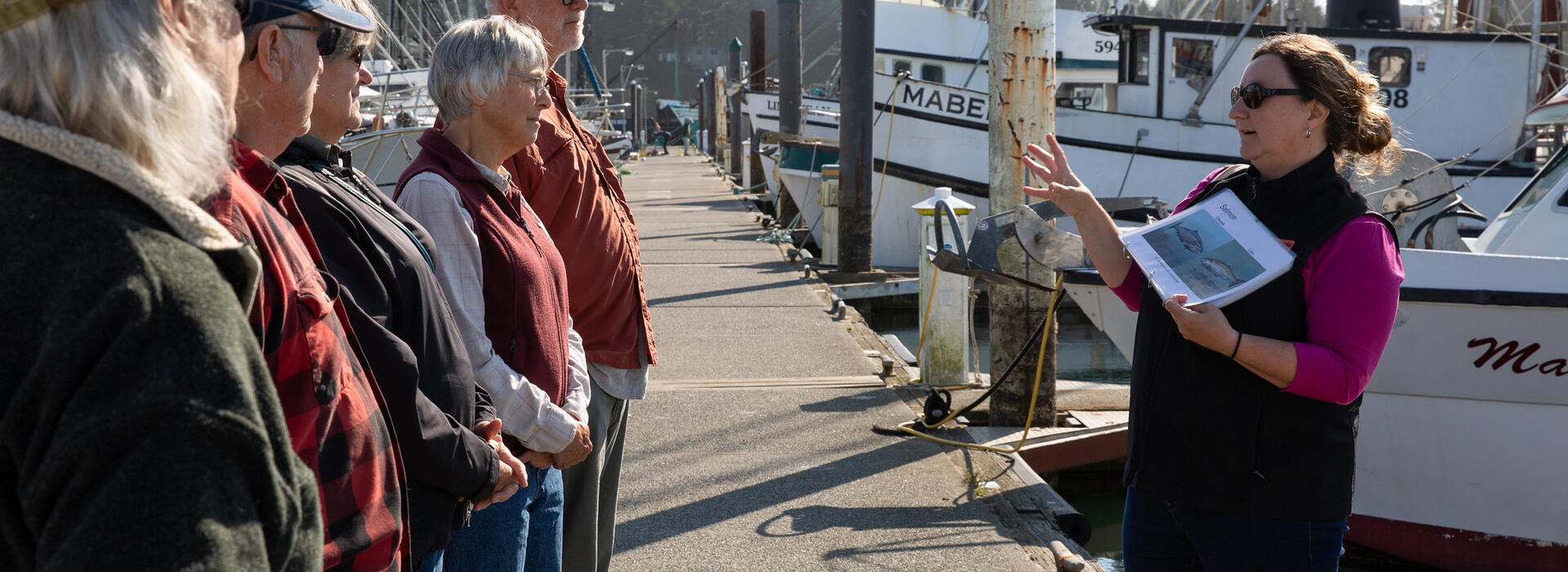
Oregon Sea Grant extension specialist Jamie Doyle leads a “Discover Oregon Seafood” tour in Charleston, Oregon. (Photo by: Gabrielle Colton).
February 20, 2026
By Rose Rimler
With dockside tours, taste tests, and a comprehensive new website, Oregon Sea Grant is reconnecting Oregonians to the state's abundant seafood resources.
"We have some of the best managed fisheries in the world right off our coast,” says Laura Anderson, founder of the Newport, Oregon restaurant and fish market Local Ocean. But many people have a misconception that “the oceans are dying, everything is over fished and resources are depleted. And it's just really, honestly not true. There are places in the world that are experiencing overfishing and illegal fishing, and that is something not to shove under the rug, but it's not a global phenomenon. There should be a really strong trust that people have with US fisheries."
The United Nations estimates that more than 80% of the fisheries off the west coast are sustainable, making these waters home to the highest proportion of sustainable fishing for any region in the world. For example, the west coast groundfish (including rockfish, Pacific cod, hake) fishery has been heralded as one of the greatest conservation success stories of the 21st century. And Oregon pink shrimp was the first shrimp fishery to be certified by the Marine Stewardship Council as sustainable.
And yet, odds are that if you stop for fish and chips or a shrimp basket at one of Oregon’s seaside restaurants, you actually aren’t eating anything caught locally. NOAA Fisheries estimates that roughly 80% of the seafood consumed in the United States is imported, and an assessment from an Oregon marine economist suggests a comparable pattern at the state level. The reasons for this are complex, encompassing global economics and bottlenecks in local infrastructure. But experts have identified one other key problem: Oregon Coast residents and visitors are disconnected from the local fishing industry.
“We find that unless people are actively involved in fishing or from a fishing family, they often know very little about what's caught here,” says Jamie Doyle, an Oregon Sea Grant extension specialist. “People don't always know what's caught here, how it's caught, how it's managed, that it is managed.”
Doyle is part of a multi-prong Oregon Sea Grant initiative that’s working to change that.
Discover Oregon Seafood
The first step was to bring people to the docks. Over a decade ago, Oregon Sea Grant started “Shop at the Dock,” guided tours of the commercial docks in Newport, Oregon. The program was a hit, and quickly became a local institution, with visitors lining up all summer long. So, in 2024, Oregon Sea Grant expanded “Shop at the Dock” to the entire state, under the new name “Discover Oregon Seafood.”
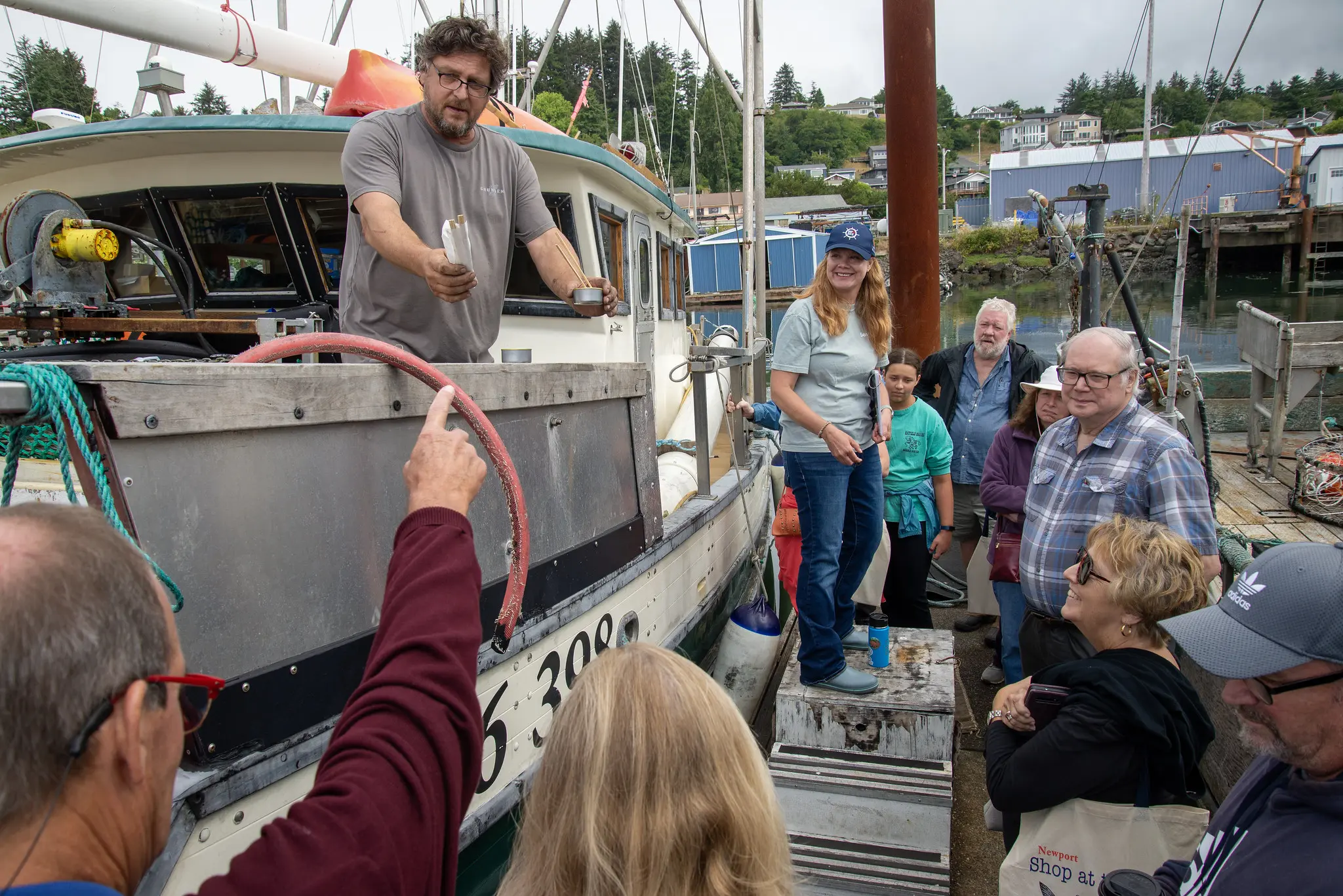
Each tour, and each port, is different. But the talking points at every location are the same: tour leaders explain what seafood is caught locally, demonstrate how fishing gear works, describe sustainability practices, and teach people how to buy seafood right off the dock.
These tours invite people to engage with the local fishing industry who otherwise may never have found a way in– like North Coast resident and tour taker Katie Kinne. “I’m a small woman in my fifties,” she says. “It’s intimidating being on the docks. There’s heavy machinery, people working, and I never want to be in the way. Women my age are often taught not to take up space. On these tours, it was nice to hear: "It's okay for you to be here.”
Kinne has now gone on Discover Oregon Seafood tours in three different ports. What sticks out to her most are the human moments, when she felt she was connecting with fishermen and women as real people. In Garibaldi, she recalls, a fisherman fed scraps to the local seagulls he’d given names. In Ilwaco, she and fellow tour-takers talked with a woman who’d spent 30 years fishing in Alaska. “Her knowledge was so vast,” Kinne says. “It was really incredible to hear her stories.”
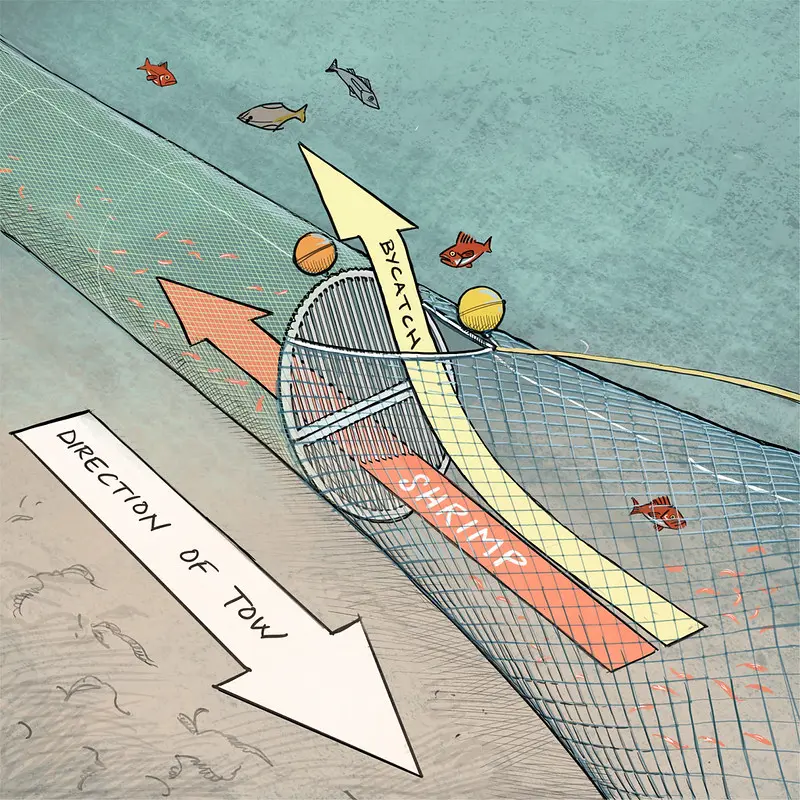
She was also impressed by the sustainable fishing equipment that tour guides pointed out, such as the bycatch reduction device used to catch pink shrimp. A grate is sewn into the net and that prevents larger fish from being caught in the shrimp net. Similar to turtle excluder devices used in the South Pacific and Atlantic ocean, these devices and other measures have tremendously reduced the amount of bycatch in the pink shrimp fishing industry.
“People don’t always realize there’s management, that it’s not a free-for-all,” Doyle says. “Being able to touch the gear helps them see the conservation measures built into the fishery.”
Last year, Oregon Sea Grant led tours in eight different coastal towns, with almost 400 people in attendance.
Beyond the Catch of the Day
Kinne now feels empowered to buy seafood right off the dock, like the fresh tuna she sometimes sees on offer. But the point of Oregon Sea Grant’s tours is not just to encourage people to buy seafood directly from the fishing community or only on the day it’s caught. Instead, it’s to help people understand the broader fishing economy and how to get the most out of it.
To that end, Oregon Sea Grant along with additional funding from NOAA have helped support several studies, carried out by researchers at Oregon State University, examining the quality and palatability of frozen seafood. Working with the OSU Food Innovation Center in Portland, researchers asked consumers to rate seafoods based on type of species, freezing method, and time frozen– up to two years. Results from these blind taste tests show that frozen seafood holds up remarkably well.
That’s something Anderson, of Local Ocean, already knew from experience. But now she can back this up with data, which is helpful when she explains her products to customers. “Like albacore tuna, for example,” she says. “You can only catch albacore tuna for about four months in the summertime, but we want to sell it all year round, so we buy our entire year's supply in the tuna season and hold it frozen and cut it out.”
Without frozen seafood, “we'd have a lot of loss trying to push that much fish through a fresh window. We would have an incredible amount of food waste, and we'd also be degrading the experience for the consumer.”
Discover West Coast Seafood
Last fall, Oregon Sea Grant expanded its seafood education efforts once again, joining forces with Washington Sea Grant and California Sea Grant to create a new website: Discover West Coast Seafood. The site serves as a seafood literacy hub for the entire West Coast. Visitors to the site can learn about seafood from top to bottom, starting with where and how fish and invertebrate species are caught to how to cook them. Sea Grant agents commissioned hand-drawn illustrations of fishing gear from an illustrator and fisherman in Alaska, who crowdsourced the accuracy of the images with other fishermen on social media. They also collected seafood recipes from chefs, designed for a variety of skill levels.
Ultimately, the goal isn’t just to get people to the docks or to meet a real-life fisherman: the goal is to demystify local seafood, one bite at a time.
