

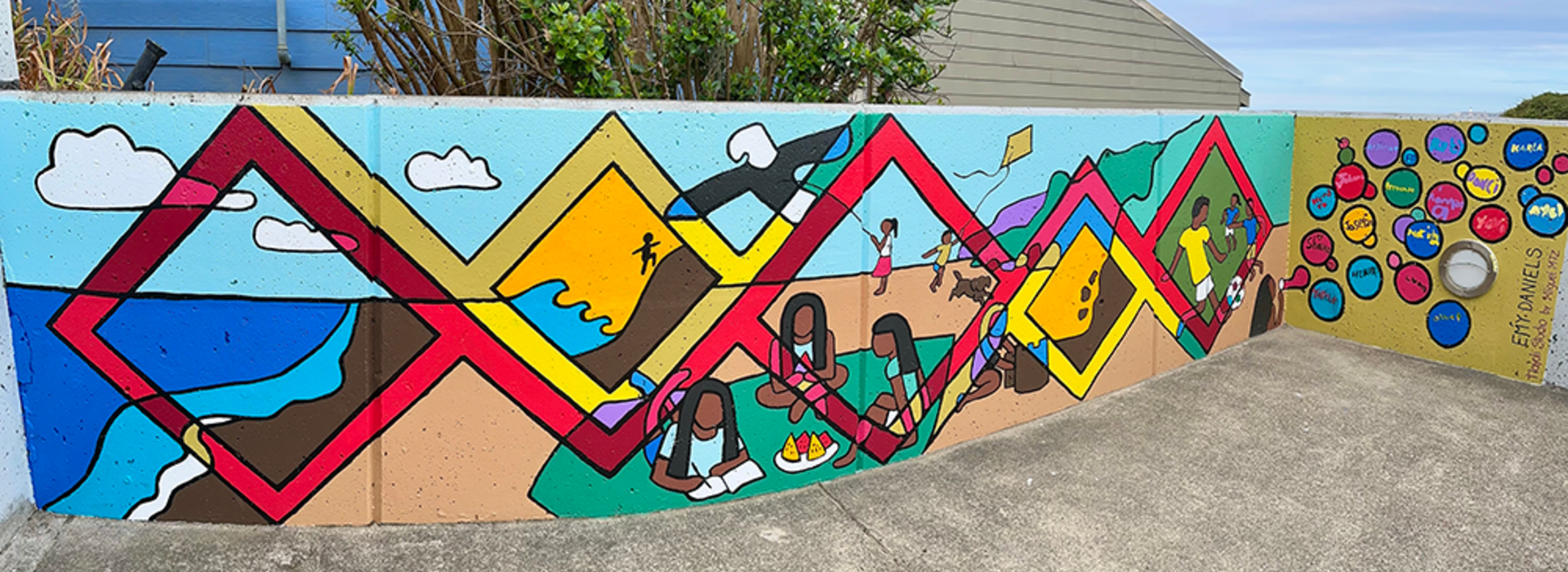
“A Resilient Newport: Respect the Coast and Play Safe,” a mural painted by local Latinx youth in collaboration with artist Emy Daniels and partners, promoting coastal safety and community resilience. (Photo by Alli Masterson).
February 19, 2026
By Juliet Grable
Researchers are using art and science to bolster hazard preparedness among Oregon coastal residents
In a new mural adorning the staircase at Nye Beach in Newport, Oregon, children fly kites, share snacks, and play soccer on the beach while a dog scampers alongside. Interwoven are framed scenes of hazards: rocks slide off a cliff; and a child runs up a hill to escape an oncoming tsunami wave.
The colorful mural was painted by Latine youth in a project that combined hazard awareness, cultural heritage, and art.
From flooding and rip tides to wildfires and earthquakes, the Oregon coast is vulnerable to a range of hazards. But not all residents are equally prepared to respond when hazards occur.
Oregon Sea Grant Extension and Oregon State University (OSU) researchers are forging partnerships with coastal and tribal communities to better understand how residents view hazards and to co-create strategies that bolster preparedness.
“We’re taking a very surgical approach so we can discover what are those actual hurdles in this specific case, and how can we overcome them?” says Jenna Tilt, social scientist and associate professor in the College of Earth, Ocean, and Atmospheric Sciences at OSU.
The Latine community in and around Newport is one case. Some residents here are newcomers to the Oregon coast; some speak English as a second language; some are low-income.
“If you're a low-income household, you’re going to be most worried about your job, putting food on the table, and your kids’ education,” says Felicia Olmeta Schult, Oregon Sea Grant Extension coastal hazards specialist.
The research team is engaging youth to help understand this community’s needs and perspectives.
“Children's voices and children's understandings are sometimes not included in discussions about serious issues that affect a population,” says Emma Gleeman, a graduate student in Geography and Geospatial Science at OSU. “When kids get excited about a topic, they talk about it and help their parents understand and be aware.”
In July of 2024, with help from Tilt, Olmeta Schult, and the Arcoíris Cultural Center, Gleeman organized a two-week bilingual summer camp for youth.
The camp’s programming, which included fun activities like scavenger hunts and tidepool explorations at Nye Beach and Seal Rock, helped the researchers understand how youth view coastal hazards and study which engagement methods are most effective.
With help from Newport artist Emy Daniels, the campers created nature journals they took to the beach; they also painted and sculpted coastal hazards and tidepool creatures they observed.

Through journals and one-on-one conversations with the kids, Gleeman observed that the children enjoy strong connections with family and are curious about nature; many connected the ocean with their parents’ livelihoods. She discovered that the most effective engagement strategies combined classroom learning with hands-on art or photography. In one “Photovoice” exercise, the group followed a classroom presentation with a trip to the beach; there, the kids snapped photos of features that looked vulnerable to landslides and discussed the images with Gleeman.
“Seeing them project their understanding of those topics onto the landscape was really exciting,” says Gleeman.
Art-based approaches helped the researchers discuss topics that both kids and adults can find frightening.
“When you scare somebody, you turn them off; they become fatalistic,” says Tilt. “Having different ways to approach these pretty serious topics helped alleviate some of that fear.”
The research team developed the community mural project to deepen engagement and create a lasting, public installation about coastal hazards and community resilience. Emy Daniels and Miguel Madano Martinez, another local artist, led a series of workshops with youth and adults to inform the design.The artists created a “paint-by-numbers” template, and 15 children helped paint the mural, which integrates colors and patterns from Guatemalan and Mexican textiles.
Interweaving depictions of a landslide and tsunami with scenes of enjoyment reminds viewers that hazards are part of life on the Oregon coast—something to prepare for, not to fear.
Multiple funding partners and a surprising amount of behind-the-scenes preparation is needed to ensure successful and effective community projects like these. The researchers will continue building on the trust and relationships they have fostered.
"It's not like we work on a project and it's over,” says Olmeta Schult. “We are in constant communication with these community-based organizations.”
Among other projects, the researchers are working with several groups of coastal residents to co-develop a multi-hazard evacuation map; they also hosted a wayfinding evacuation training with employees at a seafood processing facility in Newport.
“Doing this co-produced community engaged research is laying the groundwork together and seeing, where do we go from here?” says Tilt.
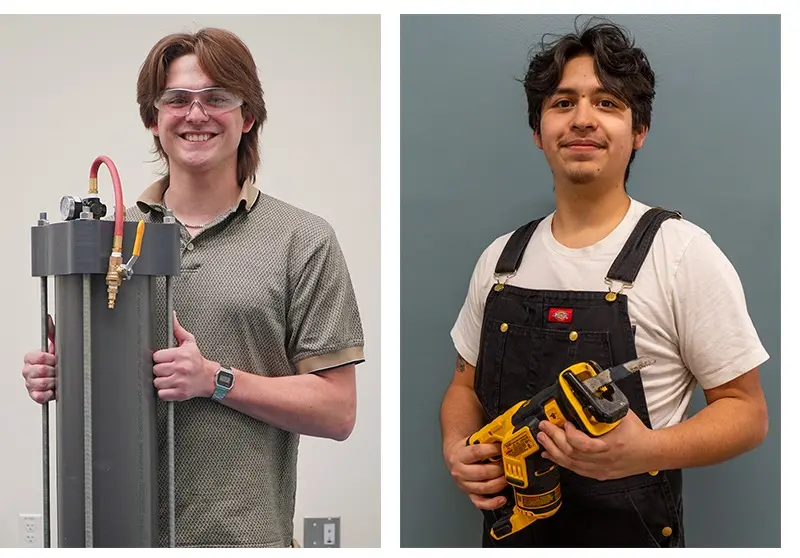
In another, separate Oregon Sea Grant-funded project, two OSU engineering students designed a beacon that can lead people to caches of emergency supplies following a disaster such as a tsunami or earthquake. The students first conceived of the beacon, which is triggered by ground shaking, while taking part in the Youth as Inventors program in high school.
This three-pronged Sea Grant approach, combining education, research, and engaging deeply with specific communities , informs strategies that ensure all coastal residents are prepared when disasters strike.
Funding Acknowledgments
The summer camp was funded through Cascadia Coastlines and Peoples (CoPes) Hazards Research Hub funded by NSF, Oregon Sea Grant (NOAA), and OSU’s Extension and Engagement Expanding Access Mini-Grant Program. Other partners included Lincoln County Public Health, and the University of Washington.The mural project was funded through a pilot grant from the CoPes Hub and is part of the Oregon Coast Council for the Arts “All Things Newport” public art initiative.