

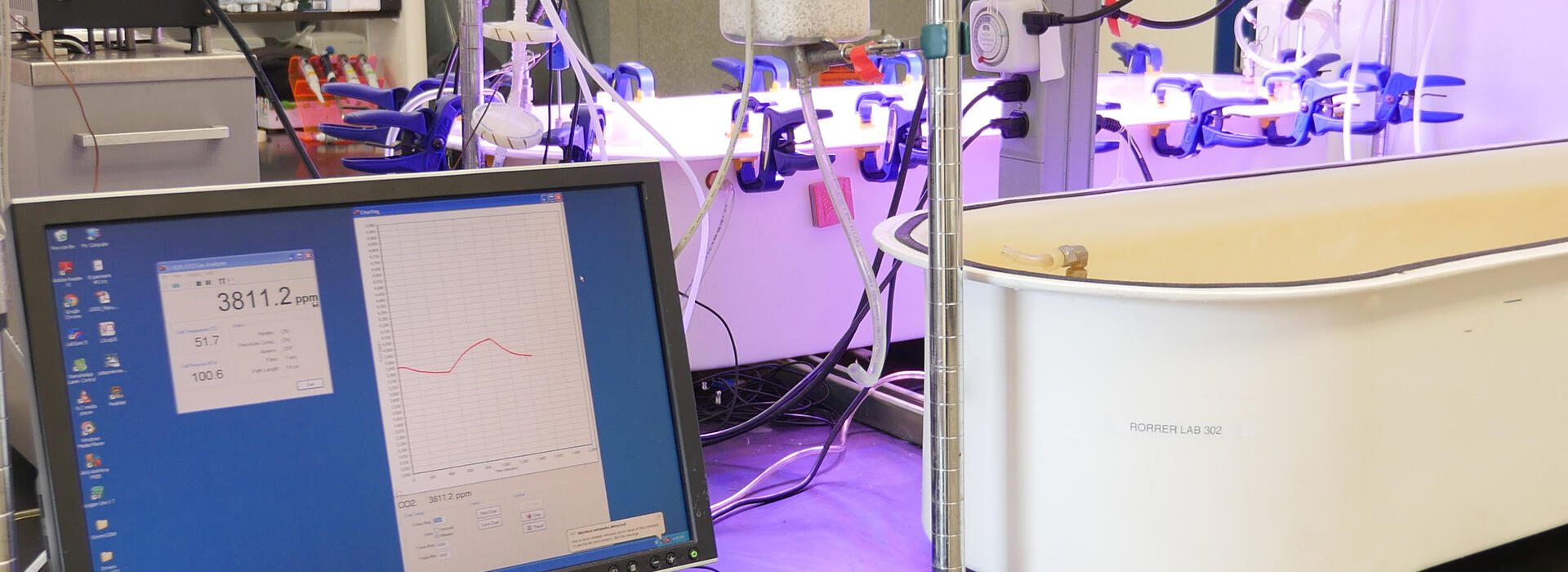
Carbon dioxide data from a tank is displayed on a computer screen in Greg Rorrer’s lab at Oregon State University. (Photo by Tiffany Woods).
February 20, 2026
By Juliet Grable
With support from Oregon Sea Grant, researchers are developing commercially viable ways to farm red seaweeds and marine invertebrates.
Hamzah Alzanbaki, a PhD student in bioengineering at Oregon State University (OSU), is cultivating red seaweed. LED lights are affixed to every surface of the oblong tank a little smaller than a bathtub. A paddle wheel turns, while dense, bushy balls of a species called Gracilaria parvispora tumble in the current.
“Due to the water motion and being exposed to light from all sides, they grow into this beautiful bowl shape,” says Alzanbaki.
This experiment is one of several projects Oregon Sea Grant is supporting to help develop intensive, land-based methods to culture marine life such as seaweeds and shellfish in Oregon and elsewhere.
The seaweed fragments in Alzanbaki’s “raceway” system can double their mass in a week.
“You want more material growing faster in a smaller volume; if you can do that, both the cost and the risk for a grower go way down,” says Greg Rorrer, professor in the Department of Chemical Engineering at OSU, who is leading the research on this project.
Red seaweeds are marine algae that grow near the shore or in the intertidal zone. Unlike rubbery brown seaweeds, species like G. parvispora are delicate and fan-like. Highly nutritious red seaweeds are popular in many Asian countries, where they are eaten fresh, dried, and fermented. Most can reproduce asexually: if you break off a piece, a new plant will regenerate from the fragment, making them ideally suited to aquaculture.
Red seaweeds have applications beyond food, including as thickeners, fertilizers, and nutritional supplements, says Rorrer. “Biochemically, they are more diverse and richer in their product potential compared to brown seaweeds.”
Another doctoral student, Arthur Veremchuk, is experimenting with a species called Agarophyton vermiculophyllum, or ohmi, which is native to East Asia. His system also uses a raceway, but instead of tumbling freely, the fragments are suspended on flat mesh panels while pumps force aerated water past them.
The system is designed to be scalable, says Rorrer. “By organizing the tissue this way, we can get about ten times more biomass in the same volume.”
Self-contained land-based systems have advantages: you can precisely control temperature, light, and pH, prevent contamination, and eliminate the risk of introducing non-native species. But pumps and LED grow lights are costly. Rorrer and his students are trying to find the “sweet spot” where inputs boost growth with the least cost.
One reason researchers are focused on land-based systems is that Oregon currently lacks comprehensive regulations for in-water seaweed cultivation.
“Seaweed really is an emerging sector across the U.S., and some of our coastal states are further along in that process than others,” says Alex Marquardt, Oregon Sea Grant Extension specialist for coastal mariculture. “In Oregon, there is no standard process or pathway where you can apply for a permit to start a seaweed farm that is in water.”
Shoreline, intertidal and near-shore waters are under different state jurisdictions, complicating matters. Marquardt is studying permitting pathways in states like Washington, Alaska and Maine to see how they can inform policy in Oregon for native species.
“The amazing thing about seaweed aquaculture is that it’s a net positive,” says Marquardt. “It just uses sunlight and nutrients that are in the water, which is pretty incredible.” In-water seaweed aquaculture could also help support kelp forest restoration efforts and mitigate local effects of ocean acidification.
With support from Oregon Sea Grant, Rorrer and Oregon Sea Grant Extension Specialist Sam Chan have established the Red Seaweed Learning Collaborative to share research results with colleagues and encourage others to learn about and participate in land-based red seaweed aquaculture. But successful commercialization will also require cultivating a taste for these products here in the United States.

“America is not primarily a seafood-eating country,” says Chris Langdon, research scientist at OSU’s Coastal Oregon Marine Experiment Station. “You have to create the market.”
Langdon and Research Associate Ford Evans have been working with a red seaweed native to the West Coast called Pacific dulse in land-based systems, both as a primary food product and as a food source in “co-culture” systems. They first used this approach by feeding dulse to farmed abalone, essentially initiating a new industry in Hawaii and across the West Coast.
“We achieved the highest growth rates of red abalone that have ever been recorded in the literature,” says Langdon. Now, with funding from Oregon Sea Grant, they’re collaborating with private partners to co-culture dulse with purple sea urchins.
Populations of these urchins exploded in waters off the Oregon coast following a massive die-off of their primary predator, the sunflower sea star. (A bacterial pathogen called Vibrio pectenicida has been wiping out Pacific Coast sea star populations since 2013.) With nothing to check them, purple sea urchins have decimated kelp beds, leaving barren areas densely populated with starved “zombie” urchins.
Zombie urchins have no commercial value because they can’t produce roe—called uni in the sushi market—which is the primary reason they are harvested. Once the urchins access a regular food source, they begin producing roe again.
Evans has partnered with both Oregon Seaweed and OoNee Sea Urchin Ranch to co-culture dulse with urchins harvested from the kelp barrens.
The urchins are fed specially formulated food pellets, which tend to burden the system with unconsumed nutrients. Dulse “biofilters”—kept separate from the urchins so they don’t become food themselves–take up nutrients released from the urchins. In a newer experiment with OoNee, they’ve added a third species: sea cucumbers, which are a delicacy in Asia.
“Although dulse can absorb a lot of the dissolved nutrients, the solid waste the urchins produce can still be problematic,” says Evans. “We're beginning to look at what's called integrated multi-trophic aquaculture, trying to use different species to utilize all of the nutrients that go into the system.”
The sea cucumbers crawl along the bottom of the tanks, consuming solid waste; once they fatten up, they can be harvested, too.
Looking ahead, Evans wants to apply research with LED grow lights to commercial land-based seaweed operations. By varying light color temperatures, intensities, and hours of exposure, they believe they can optimize both the growth rate and quality.
"Can we scale what we have learned in these experimental and smaller-scale settings and deploy them at commercial farms along the Oregon coast?" says Evans. “That's the goal.”
Collectively, these projects will help propel seaweed and invertebrate aquaculture into a vibrant, sustainable and even regenerative industry that enhances the state's economy and creates jobs, not just for Oregonians, but throughout the U.S., as well.