About
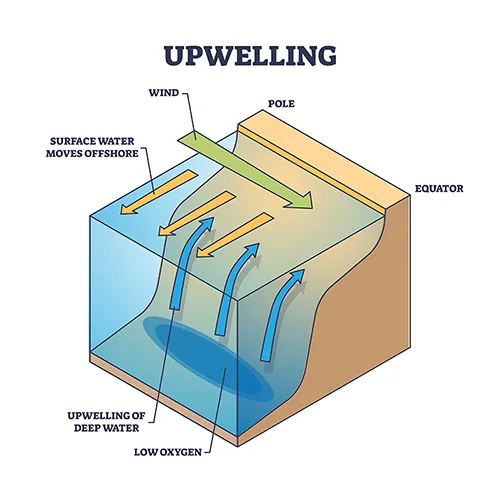
Oregon Sea Grant hosted an educational workshop with physical oceanographer Jack Barth in Brookings, OR to discuss coastal upwelling and potential effects to upwelling from offshore wind energy development on the West Coast. Jack’s presentation emphasized the significance of wind-driven upwelling in supporting marine ecosystems, particularly in areas like the California Current System, which depend on nutrient-rich waters for their productivity. He described the global mechanisms of wind creation and their role in driving ocean currents and phenomena like the Ekman Spiral, which contributes to upwelling along the West Coast.
Wind-driven upwelling is typically observed in coastal areas with strong winds. Stronger winds lead to more upwelling due to the friction, or wind stress, created at the ocean’s surface when wind blows across it. Water moving at the surface from wind stress is replaced by cold nutrient-rich water from below.
Oregon’s strong coastal winds, particularly near Brookings, makes it a desirable area for offshore wind energy development. Wind turbines, both onshore and offshore, extract some wind energy out of the natural system to generate energy. Studies show that wind speeds are reduced by about 1 m/s at a 10m height (100 feet) in the presence of wind turbine arrays (Raghukumar et al., 2022).
Recent modeling studies considering offshore wind development off the coast of California suggest that offshore wind turbine arrays could affect upwelling patterns locally but show minimal net impacts on a broader, regional scale (Raghukumar et al., 2022, Raghukumar et al., 2023). Changes in wind speed from offshore wind energy extraction were found to reduce upwelling on the inshore of wind turbine arrays and increase upwelling on the offshore side (Raghukumar et al., 2023). Historical data also indicates a trend of increased wind speed and upwelling due to climate change, with stronger coastal winds linked to warming landmasses (Barth 2025). Because of the current rates of wind speed and upwelling, scientists predict it would take 10-20 years to offset a 10-20% reduction in upwelling by offshore wind energy extraction on the west coast (Barth and Raghukumar 2025, Seventh Oregon Climate Assessment - Floating Offshore Wind Energy Infrastructure). However, further research, including observational studies, is necessary to validate models and assess the long-term ecological implications.