

Community benefits from offshore wind energy development can take many forms. The most common include formal community benefit agreements, community benefit funds, direct local investments, and nonfinancial benefits. This page focuses on community benefit agreements, which are legally binding contracts negotiated between developers and local groups that guarantee specific benefits.
Overview
On June 14th, 2024, Oregon Sea Grant hosted a webinar about community benefit agreements prior to the close of the public comment period for the Bureau of Ocean Energy Management’s Proposed Sale Notice for the Oregon offshore wind energy lease areas.
Note: The auction for this proposed sale notice has since been postponed.
Within the Proposed Sale Notice, the Bureau of Ocean Energy Management (BOEM) proposed to grant bidding credits to bidders that commit to any or all of the following:
- Supporting workforce training programs or supply chain development
- Establishing a lease area use community benefit agreement
- Establishing a general community benefit agreement
Community Benefit Agreements are legally binding agreements between developers and local groups that serve to mitigate impacts of large infrastructure projects such as offshore wind energy development. Groups that are involved in community benefit agreements often include municipalities hosting infrastructure and local community groups or organizations. Tribal Benefit Agreements also exist to ensure that tribal nations benefit from projects that may affect their lands and resources. These agreements are often tailored to meet the needs of the communities and tribes involved and address specific impacts of a project.
Elements of a community benefit agreement may include:
- Funding for local workforce development and job training programs
- Economic investments in local business
- Investments in local supply chain development
- Local infrastructure improvements
- Measures to minimize impacts on marine ecosystems and fisheries
- Funding for environmental monitoring and research
- Investments in coastal energy and climate resilience
- Grants for local projects like parks and community centers
BOEM’s bidding credits may financially incentivize developers to negotiate community benefit agreements, but community benefit agreements are not required by BOEM. Bidding credits are not the only way that benefit agreements can be secured. State policies may require developers to enter community and tribal benefit agreements. Communities and tribes can also negotiate directly with developers if they are organized and resourced.
Although community benefit agreements are intended to provide additional benefits to communities, sometimes they can be perceived as a bribe from developers to buy project support. Factors that can influence community perceptions towards benefit agreements include the structure and content of agreements, who is involved in the decision-making, who receives benefits, and the timing of the agreement.
From a local perspective, negotiating a community benefit agreement requires legal expertise, leverage, and coalitions to ensure that communities and tribes receive fair benefits.
Effective community benefit agreements often include the following characteristics:
-
They are negotiated by a coalition that effectively represents the interests of the impacted community
-
The negotiation process is transparent, inclusive, and easy to access by the community
-
The agreement provides specific, concrete, and meaningful benefits and delivers what the community needs
-
The agreement clearly defines formal means by which the community can hold the developer accountable to their obligations
Sign of a “weak” community benefit agreement may include:
- Minimal authentic community participation and representation
- Negotiations are not transparent
- The agreement provisions are ambiguous
- No enforcement mechanisms in the agreement
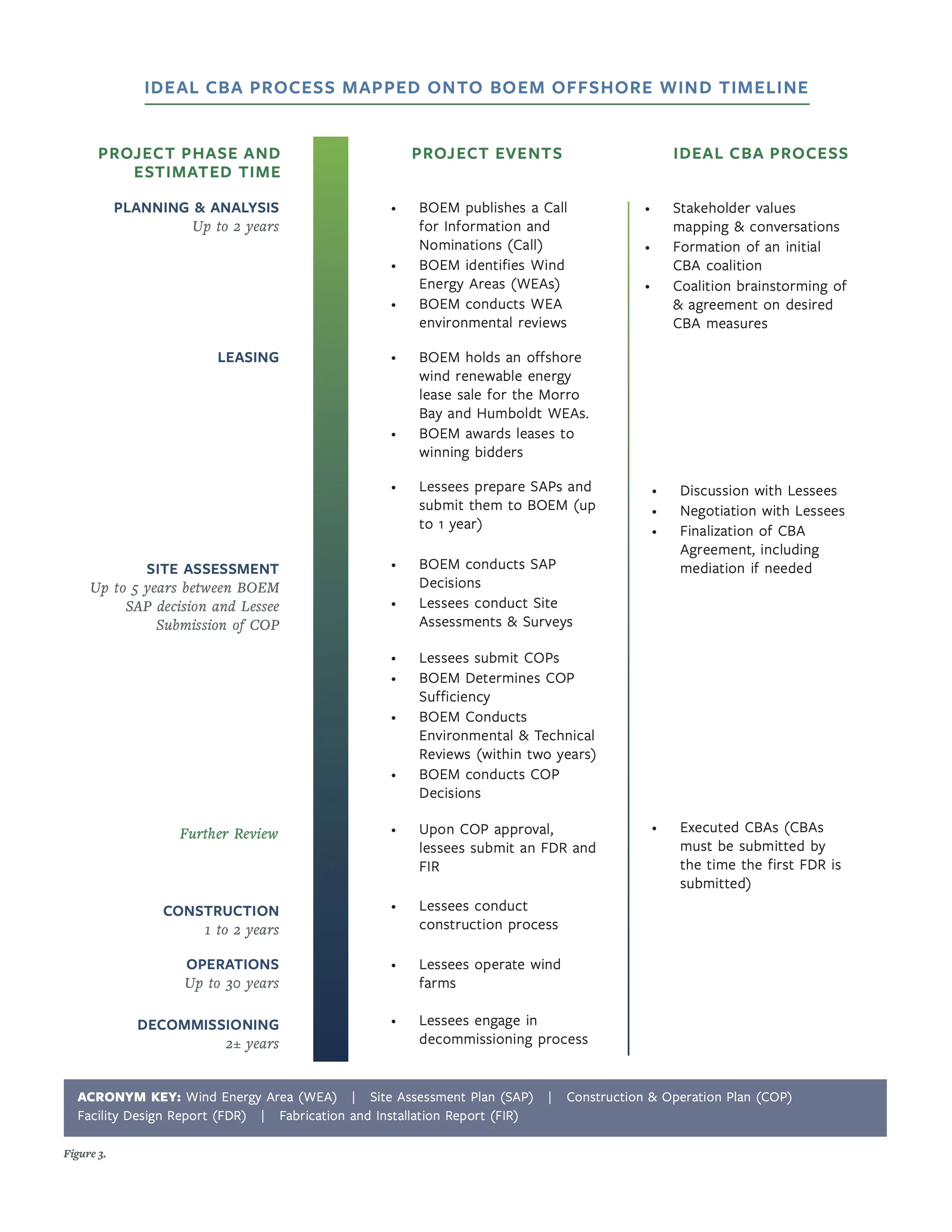
To negotiate an effective community benefit agreement, community members should start preparing as early as possible—ideally before developers secure permits or state contracts. Below is a timeline for community benefit agreement (CBA) negotiations compared to BOEM’s typical offshore wind leasing process.
Key Takeaways
- Community benefit agreements are of growing importance to many offshore wind energy developers, involved governments, and affected communities and tribes
- Community benefit agreements currently have no standard or typical definition, form, or process in the U.S.
- Community benefit agreements have complicated relationships with social acceptance and project outcomes
- Not all community benefit agreements are considered effective
- Community members should start building awareness, forming coalitions, and identifying priorities early in the offshore wind development process to prepare for an effective community benefit agreement
Speaker Info
Matilda Kreider, Wind Energy Social Science Researcher
National Renewable Energy Laboratory (NREL)
[email protected]
Katherine Hoff, Climate Change Research Fellow
UC Berkely Center for Law, Energy & the Environment (CLEE)
[email protected]