

Why Offshore?
Offshore wind resources are abundant. The National Renewable Energy Laboratory estimates that the amount of energy that could be captured from offshore wind in the U.S. is more than 420,000 MW (4,200 GW), or 13,500 terawatt-hours per year of generation.1 This is equal to three times the amount of electricity consumed in the U.S. annually.2
Offshore wind resources in the U.S. are located near many populated coastal areas with high energy demands. With 40% of Americans living in coastal areas, offshore wind resources could help meet coastal energy needs while providing economic benefits from domestic energy production.
Because the ocean does not have the same barriers that are typically found on land, like trees and buildings, offshore winds are less turbulent and can reach higher and more consistent speeds than winds over land. Many areas suitable for offshore wind energy tend to have stronger winds in the afternoon and evening than in the morning, although this effect becomes less apparent further offshore. These characteristics make offshore wind complementary to other intermittent renewable energy sources, like solar and land-based wind. For example, offshore wind arrays could continue delivering power into the evening and at night when the sun sets, and solar energy generation decreases.
Offshore Wind Turbines

Offshore wind turbines have a similar function and design to land-based wind turbines. Both types of turbines convert wind energy into electricity using these core components: blades, hub, nacelle, and tower.
The wind creates the necessary force on the blades to rotate the hub and drive a generator within the nacelle to create electrical power. Generated electricity is then transported to shore via subsea power cables and integrated into the energy grid.
The biggest difference between offshore wind turbines and land-based turbines is their size. The following considerations allow the components of an offshore wind turbine to be significantly larger than land-based turbines:
- Stronger winds & less turbulence
- Offshore winds are strong and consistent, allowing for larger blades to capture more energy.
- Less wind turbulence offshore means larger turbines can operate without the excessive wear and tear they may face from turbulent land-based winds.
- Space availability
- On land, space for renewable energy development is often limited by existing infrastructure, the open ocean allows for larger turbines with wider spacing.
- Offshore wind components are transported by large vessels at sea and assembled in specialized ports, therefore they do not have the same limitations that land-based turbine components do, like road and bridge size restriction.
- Higher efficiency
- Larger turbines generate more electricity per unit time, improving economic efficiency and reducing the number of turbines needed to achieve a certain energy production target.
- Larger wind turbines tend to have higher capacity factors. The capacity factor is a way to measure how efficient a power plant is generating electricity compared to its maximum possible output. Offshore wind energy plants have an average capacity factor of 40%, while onshore wind energy plants have a capacity factor around 34%. 3,4
- Technological advancements
- Improvements in composite turbine materials have enabled the innovation of large offshore turbines, like the Vestas 15 MW offshore wind turbine, which has 328 ft long blades and a hub height of 492 ft above sea level.

Fixed vs. Floating Turbine Foundations
Most of the installed offshore wind turbines around the world are on fixed-bottom foundations, meaning that the turbine foundation is directly fixed, or attached, to the seafloor. Fixed-bottom turbines are suitable for shallow depths up to 60 meters (200 feet). Fixed-bottom turbines are being installed and planned for areas on the U.S. East Coast where the continental shelf is broad and relatively shallow. Global offshore wind energy development has expanded substantially over the last 30 years. European countries like the United Kingdom, Germany, the Netherlands, and Denmark have been at the forefront of global offshore wind energy deployment, driven by strong policy support and mature supply chains. Today, Asia has the most installed offshore wind capacity with substantial growth in China, Japan, South Korea, and Taiwan. In 2023, the global offshore wind energy generating capacity, mostly from fixed-bottom arrays, was 75,200 MW (72.5 GW).5

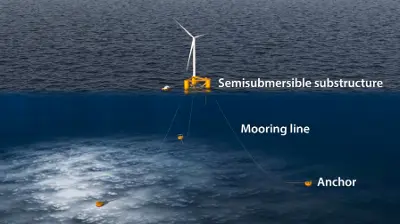
More than half of the U.S.’s offshore wind energy potential exists over waters that are too deep for fixed-bottom turbines, like areas off California and Oregon. In depths greater than 60 meters, floating offshore wind turbines are used. Floating turbines have buoyant foundations which are anchored to the seafloor with long cables, or mooring lines. There are various types of floating foundations, mooring systems, and anchor designs that can be used depending on depth, ocean conditions, and seafloor features.5

Power Transmission
Power generated from offshore wind turbines is transmitted through a series of connection points to integrate the electricity into the onshore power grid.5
- Inter-array Connection
- Medium voltage alternating current (AC) power from the turbine nacelle is transmitted down the tower and through a series of inter-array cables connecting turbines together. These cables typically run from one turbine to another 3-5 turbines before connecting to an offshore substation where the voltage is boosted to support long-distance transmission to land.
- On the west coast, these offshore substations must be floating given the lease area depths. Floating substations for offshore wind share many similarities with floating platforms used for the offshore oil and gas industry.
Image
Graphic showing the connection between the dynamic power cable and the buried static power cable used to export power from a floating offshore wind array. Dynamic cables are not necessary for fixed-bottom offshore wind. Image from Joshua Bayer, National Renewable Energy Laboratory. - Exporting Power to Shore
- A high-voltage export cable carries the power from the offshore substation to land. Export cables are usually buried under the seabed for protection from storms, trawling, anchors, and marine life. In areas where cable burial is difficult because of seafloor characteristics, additional physical protection, like rocks or concrete mattresses can help reinforce the cable.
- For floating offshore wind arrays, dynamic cables are used to accommodate moving platforms and varying mooring system tensions. Dynamic cables are suspended in the water and connect the floating structure to the buried export cable.
-
Onshore Connection
-
The export cable will make landfall under a beach or other suitable area and connect to an onshore substation. Horizontal directional drilling or trenching, where cables are buried in dug trenches, are two common methods used for cable landing construction. Cable landfall location is chosen based on geology, minimization of social and environmental impacts, and proximity to a suitable grid connection point. Soft sediments, like sand and clay, are ideal for cable burial. Landfall sites, like recreational beaches, are restored after construction so they can continue to be used.
-
Once the power has made it to the onshore substation, it is converted to an appropriate voltage for the existing grid, and is transmitted overland, either above-ground or underground, to make connection with the power grid. Grid connections are approved on a project-by-project basis by the grid system operator.
Image
-
References
- Offshore Wind Resource Assessment. National Renewable Energy Laboratory. 2025.
- Electricity Explained: Electricity generation, capacity, and sales in the United States. U.S. Energy Information Administration. 2024.
- Onshore versus offshore wind power trends and recent study practices in modeling of wind turbines’ life-cycle impact assessments. Desalegn et al. Clean Engineering and Technology. 2023.
- Annual Technology Baseline: Offshore Wind. National Renewable Energy Laboratory. 2024.
- Floating Offshore Wind Energy Infrastructure - Seventh Oregon Climate Assessment. Oregon Climate Change Research Institute. 2025.