

How Do the Worms Form Their Colonies?
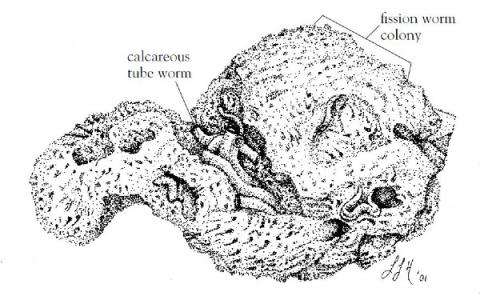
To make the rock colonies, one larval worm settles on a rock and draws calcium carbonate from the seawater to deposit around its body, thus forming a tube-shaped burrow. Once the “founding father” (or mother) worm reaches maturity, it divides in half. Two new worms are soon created from the new halves. As fission continues, the colony continues to grow, and new burrows are added to form one large, stony colony The larger colonies are usually found on reefs below low-tide level.
What Can We See on the Beach?
The colonies are often broken apart by the action of waves or secondary burrowing animals. They can then be found on beaches, tumbled smooth by the waves. Most of the material found on beaches is not fossilized but comes from a colony that was recently alive. However, there is the chance of finding fossilized Pacific fission worm colonies on Oregon beaches, dating back to the Pleistocene era. Dodecaceria fewkesi colonies can easily be distinguished from coral by the way the burrows form in many directions, often crossing each other.
This publication was funded by the National Sea Grant College Program of the U.S. Department of Commerce’s National Oceanic and Atmospheric Administration, under NOAA grant number NA16RG1039 (project number A/ESG-4), and by appropriations made by the Oregon State legislature. The views expressed herein do not necessarily reflect the views of any of those organizations.
Text by Sylvia Pauly, educational program assistant, Hatfield Marine Science Center, and Vicki Osis, marine education specialist, Extension Sea Grant, Oregon State University.
Illustration by Laura Hauck © 2003 by Oregon State University. This publication may be photocopied or reprinted in its entirety for noncommercial purposes.