


Golden Shiner Notemigonus crysoleucas
> Fish largely used for aquaculture and as a bait fish, they have been widely spread around the country and are found in Oregon and the west coast.
> They can withstand unusually high water temperatures 104°F (40°C) and low oxygen concentrations.
> They can be found in contaminated and turbid waters where other species cannot survive.


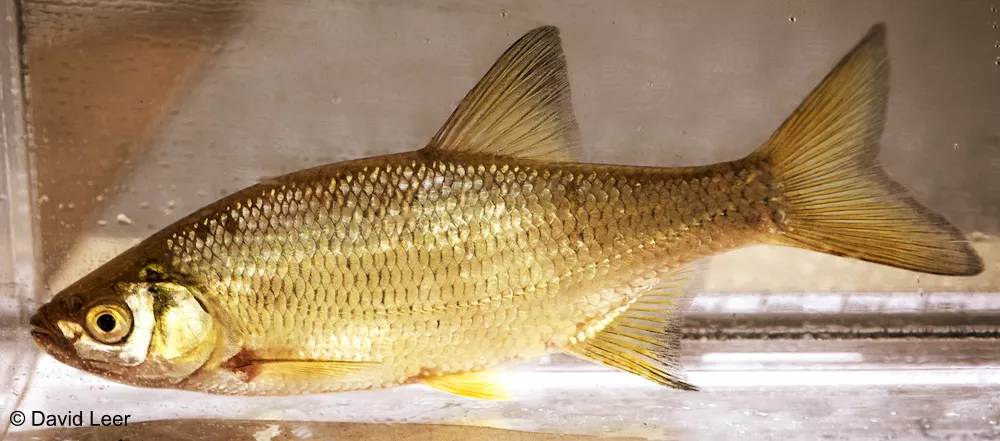

Identification Tips
> Golden Shiners are silver to yellow metallic or brassy colored with a darker dorsal side, typically greenish to olive in color.
> They have a decurved lateral line, meaning that the lateral line is not straight from head to caudal but rather dips down on the side of the body.
> Have a scaleless portion on the belly in between the pelvic and anal fins; often called a scaleless, smooth, or fleshy keel. The dorsal fin origin is behind the pelvic fin origin. They may have a dusky stripe along the side.
> Has a very deep, compressed body with a small superior mouth that angles upward.
> Commonly mistaken with another introduced species of minnow know as Rudd (Scardinius erythrophthalmus). But Golden Shiners can be distinguished by the number of soft rays in their dorsal fin (7-9 instead of 9-11 in Rudd), their scaleless keel, their yellow-green eyes (rather than red or with red spot) and their yellow-green fin coloration (rather than red).
Natural History
> Adult Golden Shiners tend to spend most of their time in midwater or near the surface for easy feeding opportunities. Larval and smaller specimens prefer littoral zones for safety from larger predators.
> Both Juvenile and adult fish school heavily during the day and in the later afternoon individuals more commonly disperse by themselves into the limnetic zone to feed.
> Golden Shiners spawn in the late spring to summer and are repeat spawners, commonly spawning multiple times in one season. When spawning, large groups form and presumably swarm the female when she lays her eggs. Golden Shiners spawn over vegetation so the adhesive eggs can stick to the submerged plants, but they also spawn in Centrarchid nests.
> Maximum fecundity for a female is 200,000 eggs and individuals mature in one to two years depending on water temperature. They live 3 to 6 years.
Distribution
> This species is native to Eastern North America in all Atlantic and Gulf of Mexico drainages, including the Great Lakes, and is found as far south as southern Texas.
> West of the Mississippi is native to the states of Montana, Wyoming, and Oklahoma.
> West of Montana the species has been introduced primarily through bait fishing.
> In Oregon, they can be found in a few locations in the Columbia River and the Willamette River, also in many lakes and ponds, and is extremely abundant in Diamond Lake.
Size
> This fish ranges in size from around 3.9 to 11.8 inches (10 to 30 cm) in length. Adults are commonly 3 to 4 inches but can grow to 10+ inches in large lakes. Females tend to be larger in size than males.
Habitat
> Golden Shiners are known to inhabit a variety of habitats, and although they prefer ponds, lakes, and slower moving sections of rivers and streams. They may also be found in cool, faster-moving streams and small to medium rivers.
> Wherever they are, they tend to be associated with extensive vegetation and proximity to the shallow littoral zone.
Diet
> Golden Shiners are primarily plankton feeders, and zooplankton makes up most of their diet. However, they can also eat macroinvertebrates, small crustaceans, and plant material that may be available on the surface or upper portion of the water column.
Management Considerations
> Golden Shiners are an invasive species that can pose a problem for native fish species if not managed properly. The Oregon Department of Fish and Wildlife (ODFW) is trying to eradicate them from Diamond Lake through netting, electroshocking treatments and the introduction of Tiger Trout, a hybrid between brook and brown trout, which prey on other fish. Tiger Trout are sterile so they cannot reproduce and become a problem.
> To keep invasive species from establishing themselves in Oregon waters, the use of bait fish is illegal in the state and anyone doing this can be reported to ODFW or the state police.