

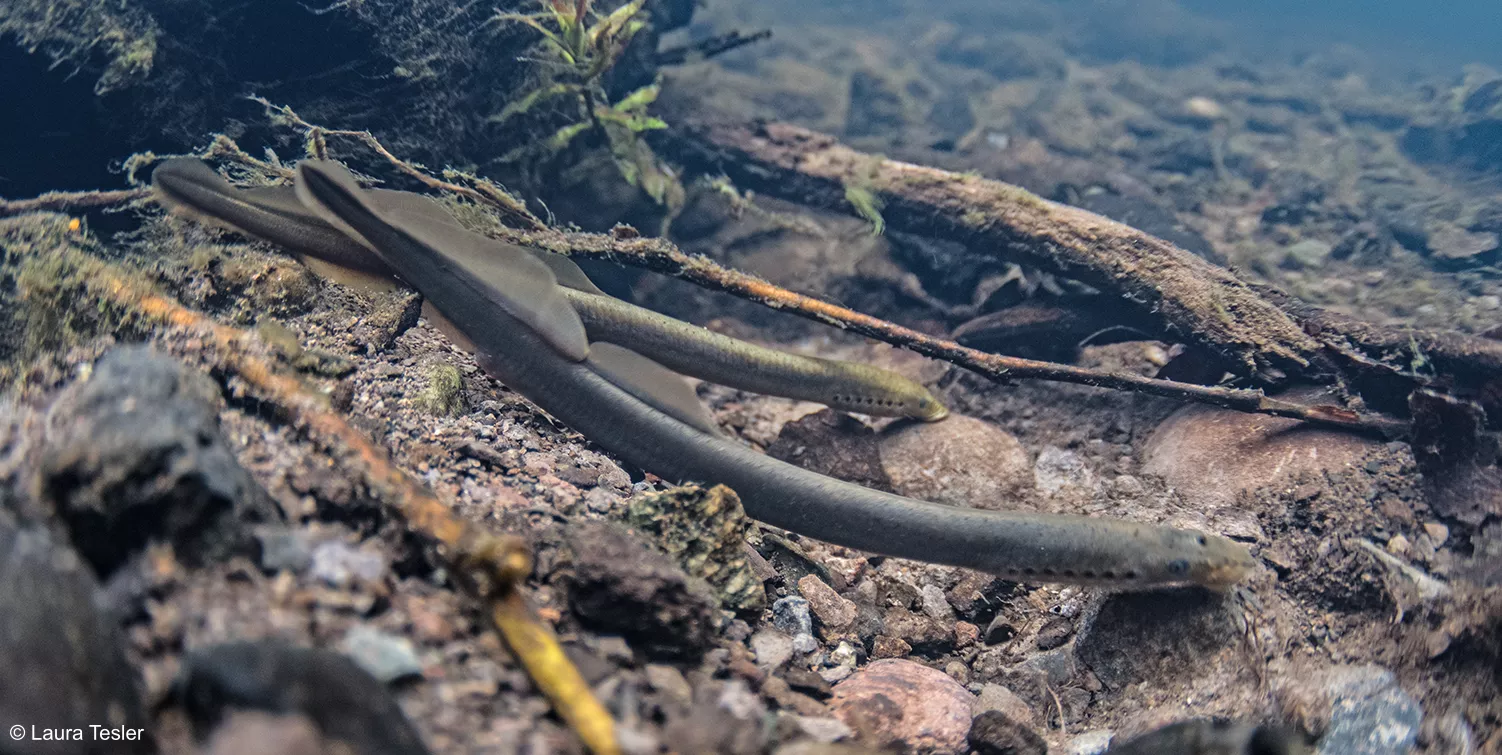
Western River Lamprey Occidentis ayresii
Conservation Status: Not listed under the Endangered Species Act
> Western River Lamprey live in freshwater, which is different than other lamprey species that also live in the ocean.


Identification tips
> Western River Lamprey are generally smaller than Pacific Lamprey and non-parasitic.
> They have similar body to eel or snake, but with seven-gill openings near the head.
> They are dark on the back and yellow to white on the belly.
> They have an expanded oral disc narrower than their head, which helps differentiate them from Western River Lamprey.
> Larvae are distinguished by heavy pigmentation on the tail, head, and above gill openings with the tail fin being clear of speckles along the tail ridge.
Natural history
> Western River Lamprey are a non-parasitic fish that is eel-like in form that occupies freshwater and coastal nearshore habitats exhibiting resident and migrant life histories.
> There appear to be declines in their populations evidenced by local extirpations from habitat loss and passage limitations.
> Spawning occurs from March to July.
> A study focused on the survival of embryonic and newly-hatched fish found that Western River Lamprey survival was the highest at 18 °C and lowest at 22 °C, similar to Pacific Lamprey, suggesting that temperatures above 20 °C cause stress.
> Larvae can live up to six years before metamorphosizing into adults. Once adults, they spawn within 6-10 months and die.
Range
> They are distributed from California to Alaska along the Pacific coast. They are found widespread throughout many drainages including the Columbia.
> Within the Willamette River basin, Western River Lamprey can be found in the main river, sloughs, tributaries, and occasionally in seasonal waterways close to the main river.
Size
> Larvae in the Willamette River are usually less than 7 inches (18 cm) and adults are usually less than 10 inches (25 cm).
Habitat
> Western River Lamprey are concentrated in headwater and low-order streams but they are also found in large rivers.
> Adults are found in gravel riffles and runs of clear cool streams while larvae are found in silt and sandy areas in a backwater of spawning streams.
> They require fine gravel for spawning, and larvae burrow in fine sediment.
Diet
> Larvae are filter feeders eating small plants and animals while adults do not feed after metamorphosis.
Conservation and Management
> Although this species is not listed under the Endangered Species Act, they are listed as a sensitive species in the state of Oregon. The Willamette River population is part of the same consideration as is the whole Columbia River basin downstream of the Bonneville Dam.
> Recent taxonomic evaluations of this species classify previously recognized species of Western Lamprey and Western River Lamprey into this current recognized species of Western River Lamprey with a new genus Occidentalis to distinguish them from Lampetra species found in Europe.
> From 2011-2013 to 2021-2023, there was a river-wide decline in abundance for lampreys (including Pacific Lamprey and Western River Lamprey together) between decades in the Willamette River.
Similar Species
Pacific River Lamprey, which do not have a tail fin clear of speckles along the tail ridge.
References
Native Lamprey of Oregon (pdf), ODFW brochure