

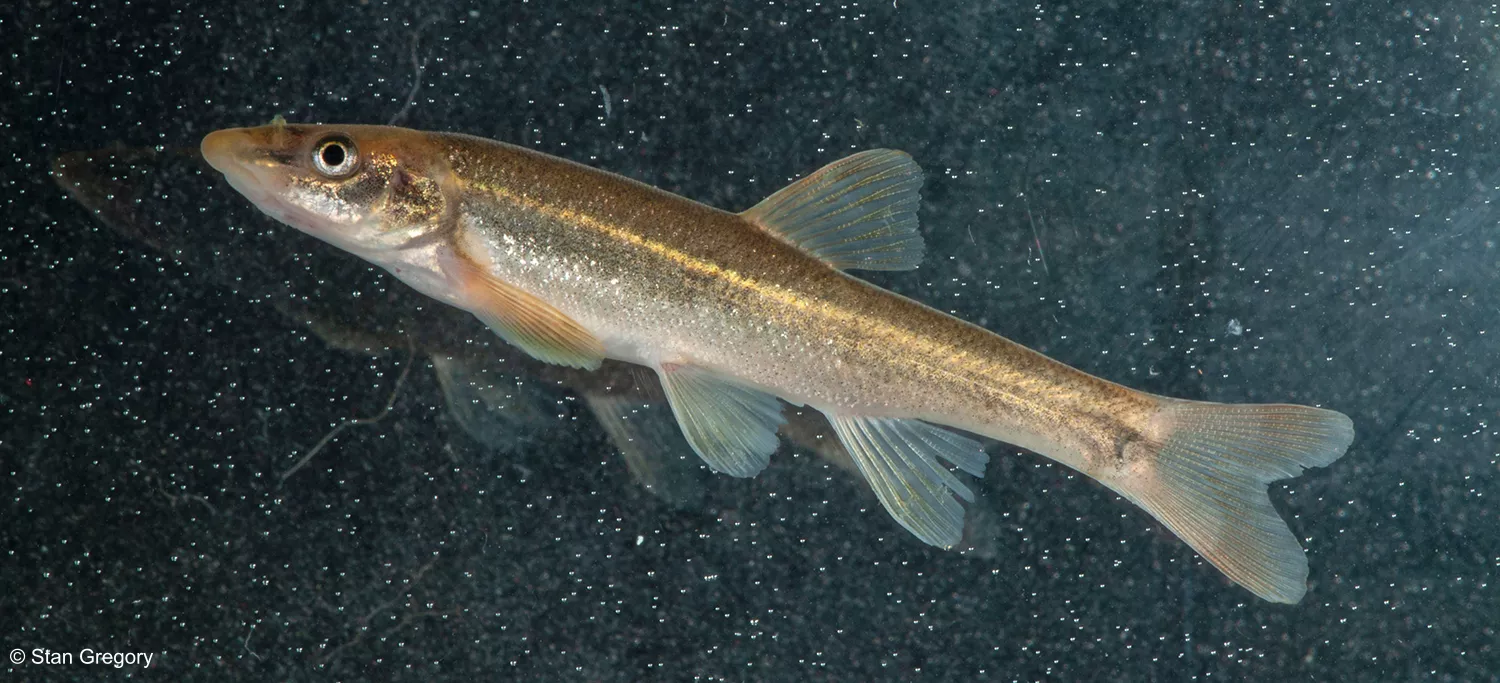
Longnose Dace Rhinichthys cataractae
Conservation Status: Not listed under the Endangered Species Act
> Longnose Dace have one of the widest distributions of any native minnow in North America.
> Longnose Dace are an important forage and bait fish.


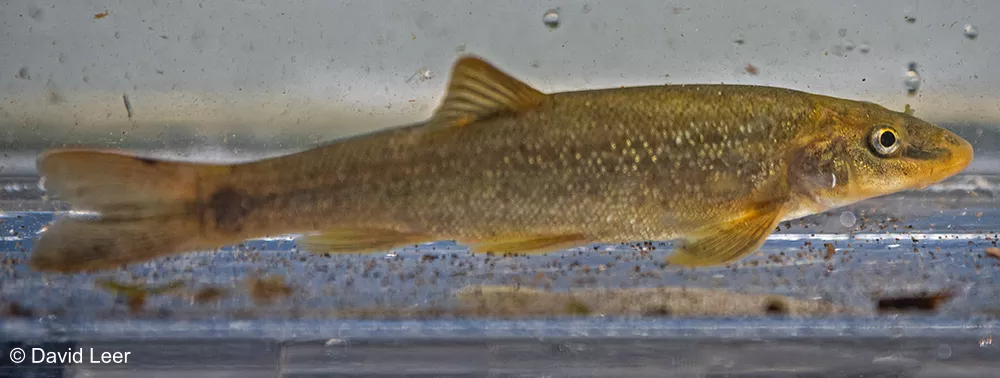
Identification Tips
> The caudal fin (tail) of Longnose Dace is moderately forked.
> Longnose Dace have a long, fleshy snout that extends in front of a subterminal (inferior) mouth. A pencil can be run along the groove of the upper lip of Speckled and Leopard Dace, but not Longnose Dace.
> There is a barbel in the corner of the mouth, and its eyes are high on its head.
> They are olive-green to brown on the top and white to yellow on the bottom with some mottling on the back and sides. Some individuals have a dark stripe along the lateral line.
> Breeding males may have red coloration on the head and fin bases.
Natural History
> Longnose Dace spawn in late spring or early summer in riffles with gravelly bottoms at around 53 °F (11.6 °C).
> No nest building takes place, but females establish and guard territories where they deposit eggs. Each female lays between 200–1200 eggs that hatch in 7 to 10 days.
> Young occupy the mid-water column while adults become benthic.
> Longnose Dace live about 5 years.
Range
> Longnose Dace are generally found above 40 degrees north, coast to coast.
> Longnose Dace are absent from Alaska and western drainages south of the Columbia and Coos rivers. They are found throughout the Columbia River basin in Oregon.
Size
> Longnose Dace are between approximately 3 inches (7.5 cm) and 5 inches (12 cm) in length.
Habitat
> Longnose Dace are found in rubble and gravel riffles, sometimes in glides and pools. They are common in fast-flowing creeks and small to medium rivers. In lakes, they prefer rocky shores.
> Juvenile Longnose Dace are found in the mid-water column while adults remain on the bottom.
> Longnose Dace prefer water temperatures between 53–70 °F (~11.5–21 °C).
Diet
> Longnose Dace eat mostly aquatic macroinvertebrates, usually their juvenile forms.
> They also eat small amounts of algae and occasionally fish eggs that may become available during the spawning seasons of other species.
Conservation and Management
> From 2011–2013 to 2021–2023, there was no apparent change in abundance or occupancy in the Willamette River.
Similar Species
> Speckled Dace, which do not have any barbels.
> Leopard Dace, which have barbels on their snout.
References
For more information, see references.