

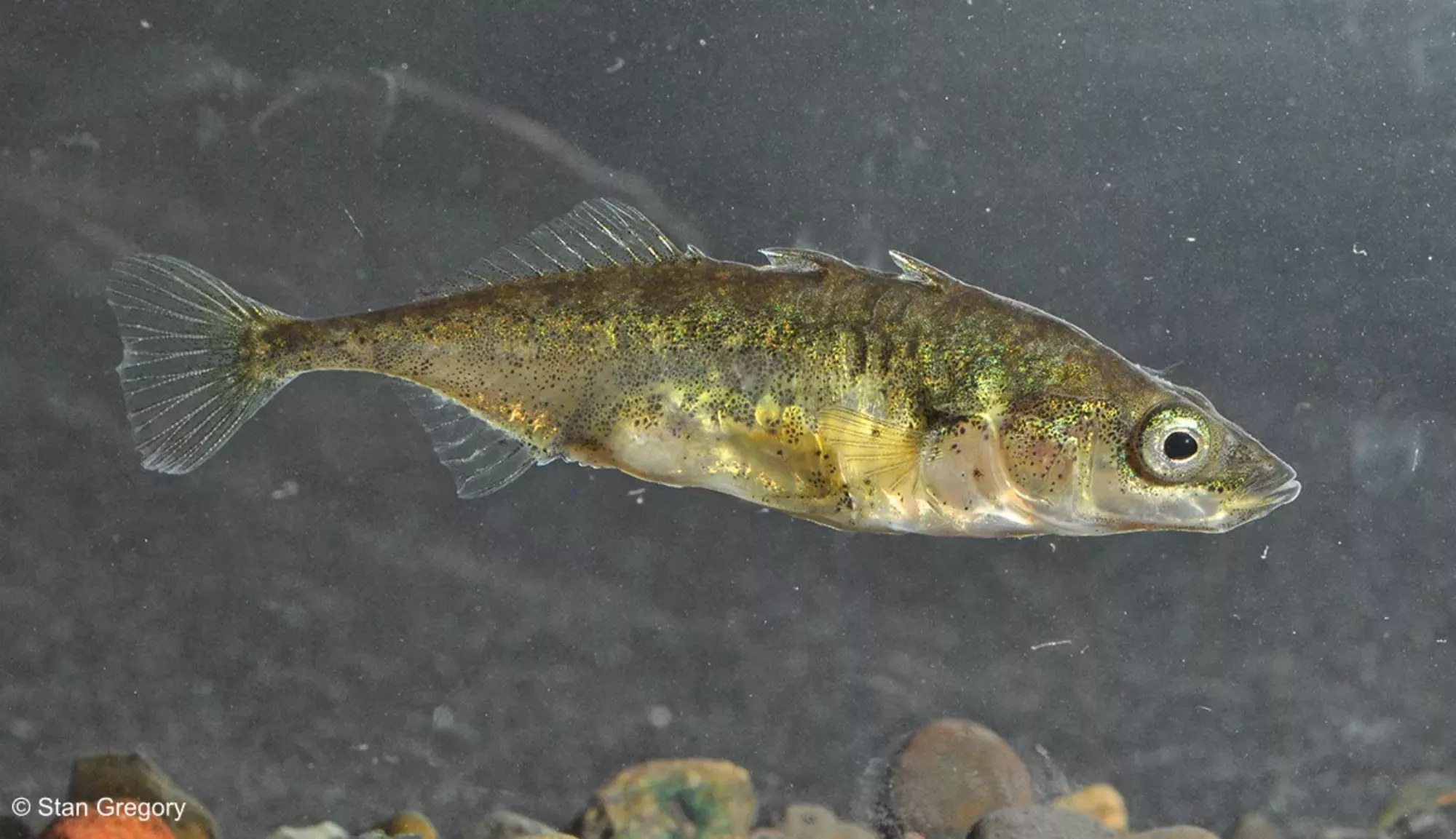
Threespine Stickleback Gasterosteus aculeatus
Conservation Status: Not listed under the Endangered Species Act
>
> Threespine Sticklebacks can swim up to 150 km inland from the sea to spawn.
> Ground-up stickleback paste was a common Indigenous Peoples food,
and their bones are found in their middens in the Pacific Northwest.


Identification Tips
> Threespine Stickleback, as their name suggests, have three dorsal spines located in front of the soft dorsal fin.
> They have a wide body with a very narrow caudal peduncle.
> Pelvic fins each have a prominent spine, and the anal fin has a smaller spine.
> They are typically greenish or brownish in freshwater, while marine forms are silver with green or brown pigmentation. During mating season, males develop red throats and blue eyes with a blue or green body.
Natural History
> Threespine Sticklebacks are unique because they can evolve to live in marine, freshwater, or brackish environments.
> They are highly schooling fish until they begin to spawn.
> Most individuals spawn at 1–2 years of age and commonly live up to four years, though some lake populations may reach eight years.
> Threespine Stickleback spawn only in freshwater; therefore, marine populations migrate inland to reproduce. During the breeding season (spring to summer), males build nests on the bottom substrate using a “sheet” of plant material glued together by a kidney secretion. Once built, males become highly territorial and protective of the nest.
> During courtship, males swim in a rapid zigzag pattern to attract females. Once a female is enticed, the male directs her to the nest, where she deposits several hundred eggs. After spawning, the male expels the female and may court additional females before fertilizing the eggs.
> Males guard the nest and fan the eggs with their pectoral fins to circulate oxygen until hatching, which occurs in 7–8 days.
> Freshwater populations can spawn multiple times per year, while anadromous populations usually die after spawning once.
Distribution
> Threespine Sticklebacks are native to North America primarily below the Lake Ontario basin but occur across much of the Northern Hemisphere.
> In North America, they range from northern Alaska down the west coast to southern California and are also found in Europe, Iceland, Greenland, and the Pacific coast of Asia.
> In Oregon, they occur throughout coastal estuaries and the Columbia River basin, including the mainstem Willamette River and the lower portions of its tributaries.
Size
> Maximum length in freshwater is 3.1 in (8 cm) and in saltwater 4.3 in (11 cm).
Habitat
> Typical habitats include small, highly vegetated streams, side channels, and ponds with shallow muddy or sandy substrates.
> Marine populations inhabit nearshore environments, while lake populations often school in littoral zones, sometimes migrating daily to open water.
Diet
> Threespine Sticklebacks are insectivorous and piscivorous, feeding primarily on macroinvertebrates, fish eggs, and fry.
> Freshwater populations consume bottom-dwelling organisms and vegetation-associated prey, while anadromous populations feed on microcrustaceans and other free-swimming invertebrates.
Conservation and Management
> From 2011–2013 to 2021–2023, there were river-wide declines in occupancy (number of sites where they were found) in the Willamette River.
References
For more information, see references.