


Rainbow Trout/steelhead Oncorhynchus mykiss
Conservation Status: Threatened under the Endangered Species Act
> Rainbow Trout and steelhead are the same species showing two different in life histories. Whereas Rainbow Trout remain in freshwater their entire life, steelhead migrate to the ocean to grow and return to spawn in freshwater.
> The same parents can produce both steelhead and Rainbow Trout offspring.
> This species along with Coastal Cutthroat Trout display the greatest variety of life histories in the genus Oncorhynchus.
> They are native to western North America and portions of Asia, and they have been introduced to every continent as a game fish, except Antarctica.
> As Pacific trout, they can spawn multiple times in their life, unlike Pacific salmon.
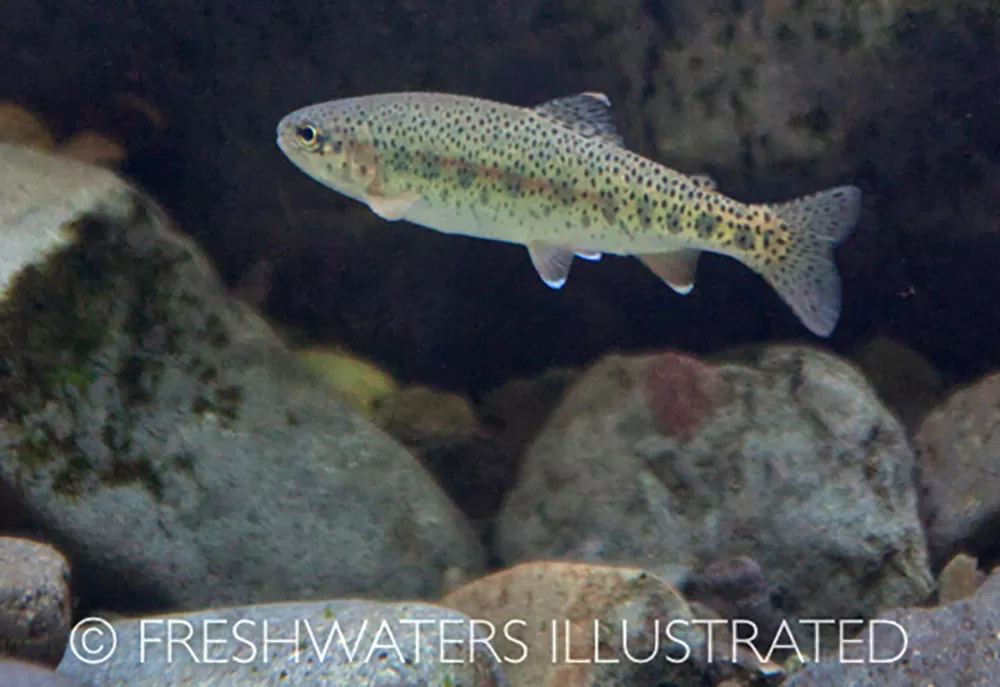
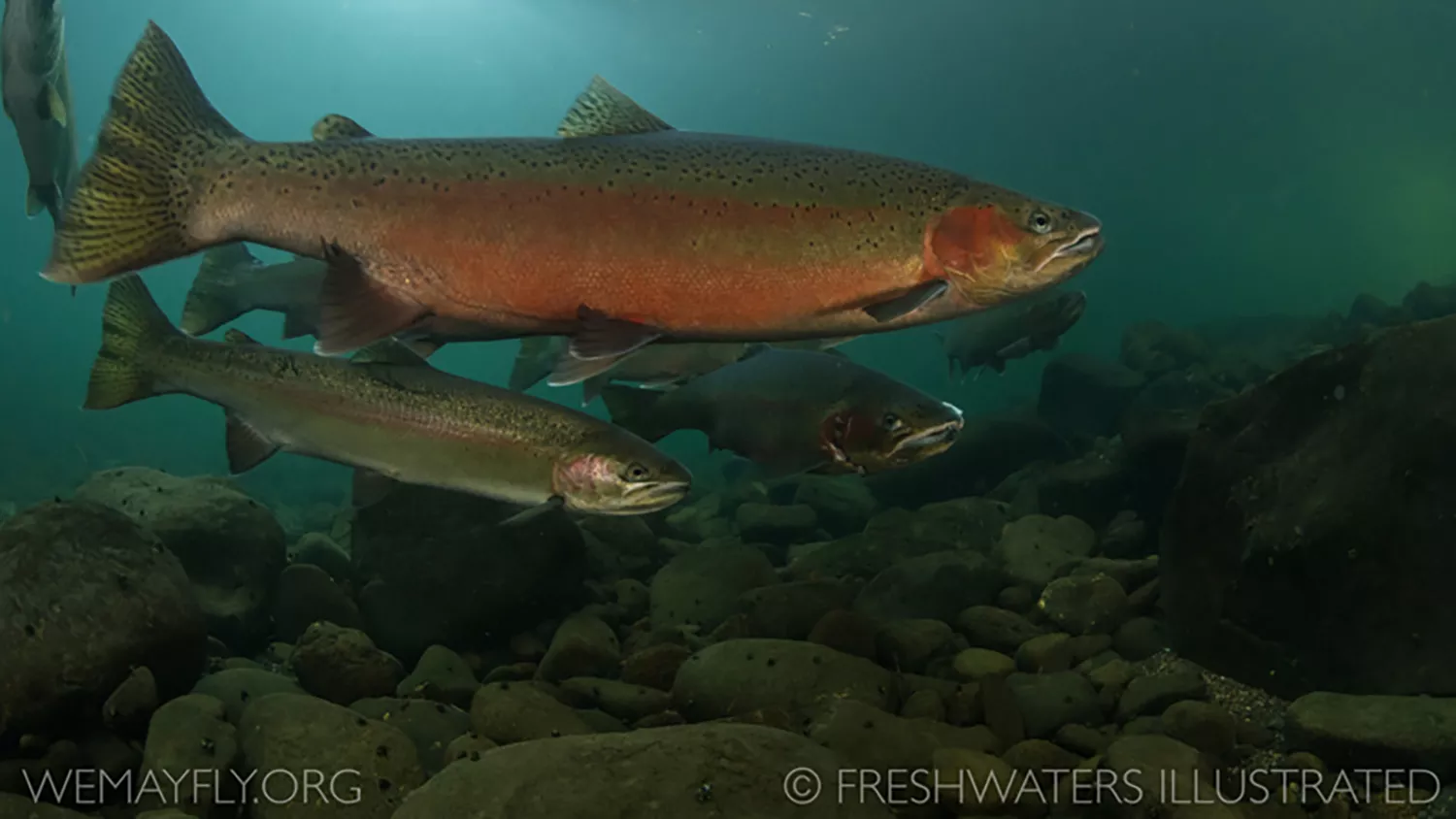
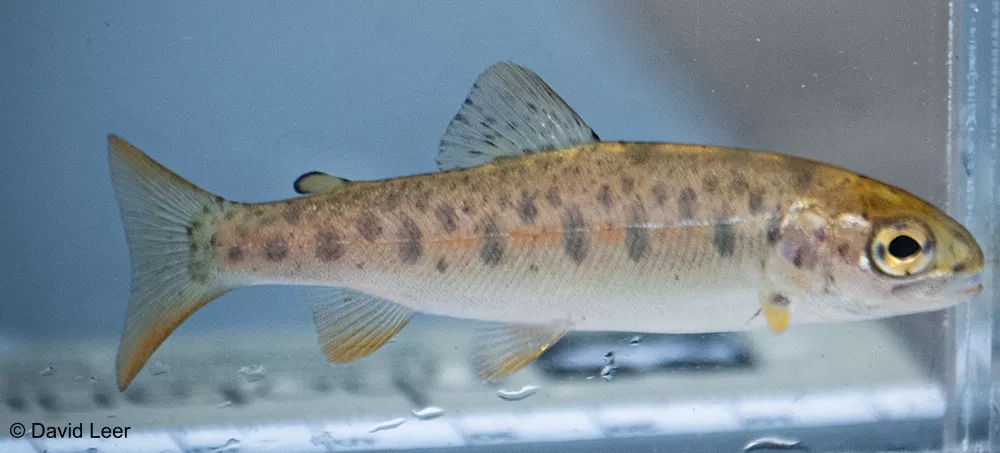
Identification Tips
> The snout is blunt and rounded.
> They have a bright red-pink stripe along the lateral line, most vivid in spawning males.
> They have a spotted dorsal fin.
> The caudal fin is squarish or only slightly forked.
Steelhead
> They are bright silver in coloration, especially after recently returning from the ocean.
> They have a steely blue to emerald-green back with a copper tone on the flanks.
> Rainbow Trout and Steelhead cannot be differentiated as juveniles.
> Once they are more than one year old, they can be differentiated from Coastal Cutthroat Trout, which have a large mouth with the hind margin reaching to or past the hind margin of the eye when shut, and orange-red marks under the chin.
Natural History
> These species have an anadromous or sea-run type (Steelhead) that migrates from freshwater to saltwater and back to their natal stream to spawn, and a resident type (Rainbow Trout) that remains in freshwater their entire life.
> Rainbow Trout west of the Cascade Range and the Sierra Nevada along the Pacific Coast are often referred to as coastal Rainbow Trout, with the sea-run form known as Steelhead. Inland Rainbow Trout groups occurring east of the Cascade Range and the Sierra Nevada are often referred to as redband trout, which can be stream-living or stream–river-living but not sea-run. The current hypothesis for the expression of anadromy or residency of O. mykiss is that it is a response to the combination of absolute water temperature and variation in water temperature, with colder thermal regimes resulting in greater residency and earlier maturation.
> Steelhead vary in their overall appearance and behavior compared to Rainbow Trout. Steelhead tend to have a more streamlined dark-olive body, with silvery-white undersides, heavily speckled bodies, and a pink to red stripe running along the sides.
> By contrast, Rainbow Trout are a silvery color with black spots on their backs and fins, and a pink band running down their sides. Their gill covers are often pink as well. Steelhead are generally much larger than Rainbow Trout as a result of feeding in food-rich ocean waters.
> Steelhead’s early residence in freshwater ranges from two to three years, but they have been known to spend up to seven years in rivers before migrating to the ocean. They typically spend two to three years in the ocean. Based on the timing of upriver migration, Steelhead are classified as part of a summer or winter run, with the type of run determined by the season of the year that the fish enter freshwater.
> Regardless of whether the O. mykiss lineage is Steelhead or Rainbow Trout, they spawn in the springtime. Spawning females dig a series of pockets or nests in the gravel where they lay their eggs. The entire area disturbed by a spawning female while digging several nests is called a redd, and its cleaner gravel makes it stand out from the darker stream substrate.
> Unlike other species of the genus Oncorhynchus, Steelhead and Rainbow Trout do not necessarily die after spawning and can reproduce for a second and even a third year. They may live 3–4 years in streams and 6–8 years in rivers and lakes. Steelhead live 4–7 years.
Range
> O. mykiss are native to western North America and parts of Asia, with their range extending from the Otay River in southern California to the Kuskokwim River in Alaska.
> In Oregon, this species is found throughout the coast, the Columbia River, and all the tributaries of the Willamette River basin.
Size
Rainbow Trout
> Weigh 1–1.5 lbs (0.45–0.68 kg) and measure between 6–16 inches (15–41 cm).
Steelhead
> Can weigh up to 45 lbs (20 kg) and measure up to 45 inches (1 m).
Habitat
> Like Pacific salmon, these trout spawn and rear as juveniles in cold-water streams with small-to-medium gravel-rich substrate, pool and riffle habitats with abundant fallen logs, as well as backwater alcoves.
> Freshwater-resident Rainbow Trout either remain in their natal rivers their entire lives or migrate between rivers and lakes.
> Steelhead rear in rivers and streams for up to three years before migrating to the ocean and back to freshwater.
Diet
> Rainbow Trout eat aquatic and terrestrial invertebrates, salmon eggs, and small fish.
> Steelhead also eat aquatic and terrestrial invertebrates and salmon eggs, but as they grow larger in the ocean, they prey upon squid, anchovies, smelt, herring, and other fishes.
> Spawning fish rarely feed.
Conservation and Management
> Steelhead are listed as threatened under the Endangered Species Act for the entire Columbia River and the upper Willamette River. They are listed as a sensitive species by the state of Oregon.
> Although neither Rainbow nor Redband Trout are listed, interior subspecies occupy only about 42% of their estimated historic range. Climate change is expected to further reduce the distribution of Redband Trout in the interior. Most declines have resulted from habitat impacts and the shrinking of spawning routes due to dams and other diversions. Siltation from forestry practices and erosion from urban and agricultural development have also degraded spawning beds.
> From 2011–2013 to 2021–2023, there was no apparent change in abundance or occupancy in the Willamette River.
Similar Species
> Coastal Cutthroat Trout have orange coloring under their operculum.
> Chinook and Coho Salmon have more deeply forked tails and generally less spotting on their bodies.
References
For more information, see references.