


Pacific Lamprey Entosphenus tridentatus
Conservation Status: Not listed under the Endangered Species Act
> Pacific Lamprey are culturally important to Native Americans.and a key part of the diets of Indigenous Peoples. In fact, there is an indigenous fishery for them at Willamette Falls.
> They have lived on Earth for at least 400 to 450 million years. This makes Pacific Lamprey one of the longest-lived vertebrate species on the planet, predating most trees!
> They are also called three-toothed lamprey.

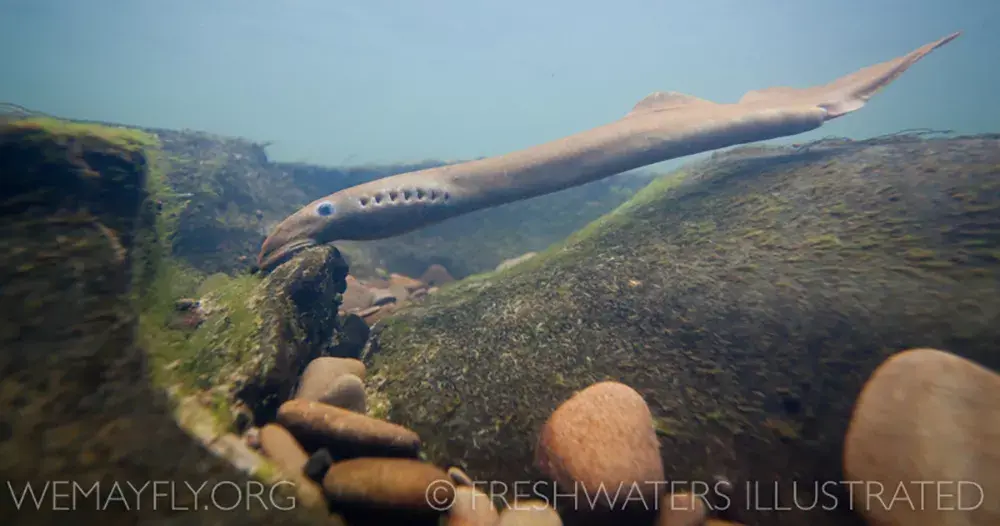

Identification Tips
> Pacific Lamprey looks like an eel, but they lack paired fins, gill slits, jaws, and scales. They do have gill openings.
> Pacific Lamprey have three prominent teeth on the anterior end of the oral disk, followed by many other teeth on the posterior parts of the oral disk.
> They are a brownish color but become silvery and reflective when migrating to the ocean.
> As larva, Pacific Lamprey can be distinguished from Western River Lamprey because the lighter caudal ridge pigment fades near the tip whereas other lampreys have clear or speckled coloration along the caudal ridge.
Natural History
> They are sea-run fish, requiring connectivity among ocean, estuarine, and freshwater habitats to complete their life cycle, similar to Pacific salmon and trout.
> Adult lamprey spends 1-3 years in the ocean and have a jawless, sucker-like mouth that allows them to be parasitic on other fish during their oceanic phase.
> They return to freshwater in the spring, with upstream migrations occurring from May to July, where they spawn in freshwater the following March through July.
> Spawning usually occurs in wider, low-gradient rivers (<2 percent slope).
> After emergence, larvae (called ammocetes) experience a lengthy larval stage that lasts 3–7 years, during which time they burrow into sandy substrates.
> At broad spatial extents, studies show that Pacific Lamprey larvae are positively associated with water depth and open riparian canopy. Patchiness in larval occurrence is observed at fine spatial extents and is associated with low-water velocity, channel unit morphology (pool habitats), and the availability of fine-grained sandy habitats suitable for burrowing.
Range
> Historically, Pacific lamprey was found from Hokkaido Island, Japan to Baja California, Mexico all along the northern Pacific Rim and into the interior west of the Rockies Mountains in North America.
> West Coast of North America, their populations have been extirpated from higher sections on many rivers because of migratory barriers such as dams.
> Currently, they are found in all rivers in Oregon, including throughout the Willamette River. The only places Pacific Lamprey is not found in Oregon are upper portions of rivers with barriers; including the Snake and Columbia Rivers.
Size
> They grow to be 15 to 25 inches (38.1 to 63.5 cm) in length and around 1 pound (0.45 kg) in weight.
Habitat
> Pacific Lamprey requires optimal freshwater and saltwater habitats.
> In freshwater, loose and fine gravel is needed for spawning, and very loose and soft benthic material is needed for larval development.
> In marine habitats, they have been found in depths of 300 to 2600 feet (91 to 792 m) below the water’s surface and from a few miles from shore to 62 miles (100 km) from shore.
Diet
> Pacific Lamprey becomes parasitic as adults feed on other organisms such as sharks, flatfish, salmon, pollocks, and rockfish.
> When they are larvae, they are filter feeders consuming mostly organic sediments comprised of plant (algae and diatoms) and animal material.
Conservation and Management
> Pacific Lamprey are considered a species of concern at the federal level in the United States and are a State of Oregon sensitive species.
> From 2011-2013 to 2021-2023, there was a river-wide decline in abundance for lampreys (including Pacific Lamprey and Western River Lamprey together) between decades.
Information Gaps
> Little is known about their freshwater ecology and more specifics of maturation and environmental tolerance are needed.
> More research is needed to identify ideal ocean and freshwater habitats aside from spawning requirements.
Similar Species
> Western River Lamprey, which have lighter caudal ridge pigment that fades near the tip