


Pumpkinseed Lepomis gibbosus
> Pumpkinseed can live up to 12 years of age.
> They have been introduced across North America and Europe.
> Because Pumpkinseed create nests near other sunfish, hybridization with other sunfishes is common.


Identification Tips
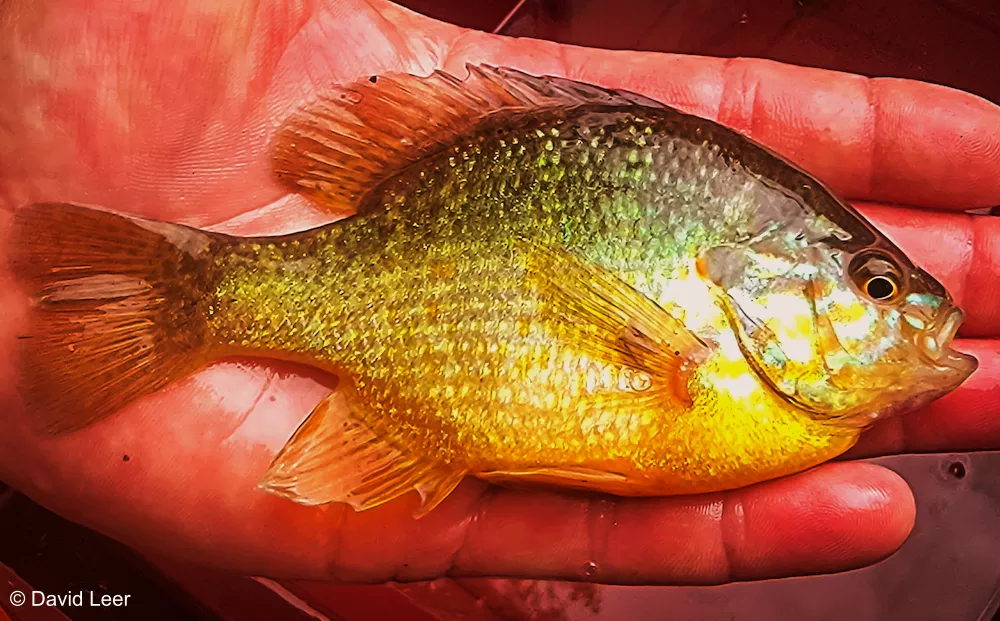
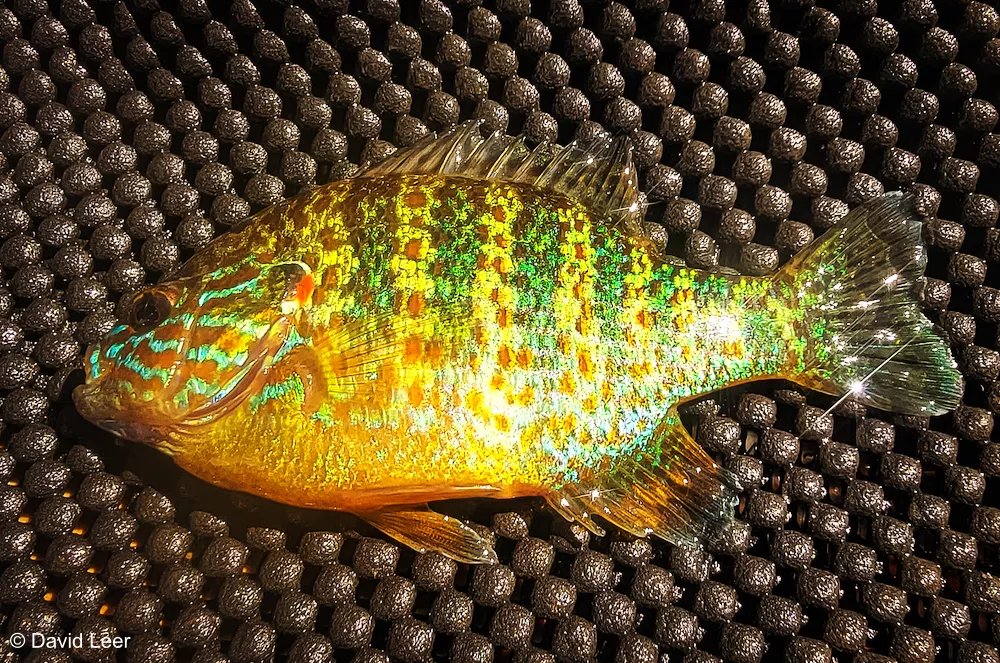
> They have a small bright orange to slightly red dot or tab on the end of the gill plate following a black dot.
> They are mostly blue with blue on its head and can have yellow to orange colors on their underside. They have orange “seedlike” dots on the sides of the fish along with spotting on the posterior of the dorsal fin and can have bright blue stripes radiating from the eye to the end of the gill plate.
> They are shaped like sunfish, which are laterally tall, but skinny resembling a plate. The first dorsal fin has 10 spines and is fully attached to the second dorsal fin. The pelvic fins have 1 spine and the anal fin has three spines.
Natural History
> In winter, adult Pumpkinseed aggregate in large groups. Males will move to shallow spawning grounds to create nests. Once the nest is created, females will come and scout the nest, eventually laying their eggs on the nest along with the male releasing his milt. Females can spawn in multiple nests and more than one female can use a nest. Spawning typically occurs in spring to summer when the water is between 13 to 28 ⁰C. Males reproduce multiple times in a season with eggs hatching in 3 to 5 days.
> After the young emerge as fry they will live in the nest for about 5 days under the males' protection. The male provides extensive protection by fanning the nest and returning straying young to the nest with his mouth. After the fry can feed themselves, typically about 10 days after hatching, they will leave the nest.
> After 2 years individuals will reach sexual maturity.
Range
> The Pumpkinseed is native the Atlantic Slope drainages from New Brunswick to South Carolina, including in the Upper Mississippi River, Great Lakes and Hudson Bay.
> In Oregon, they are commonly found in ponds and lakes, but are also well established in the Columbia River Basin and throughout the Willamette River. They were first introduced into the Pacific Northwest in the Willamette River in 1893 by the U.S. Fish and Wildlife Commission.
Size
> Their size ranges from 12 to 19 cm (4.7 to 7.5 inches) in their native range, and average size in nonnative range is typically smaller ranging from 8 to 10 cm (3.1 to 3.9 inches).
Habitat
> Pumpkinseed are commonly found in shallow rocky habitats or associated with aquatic vegetation or large woody debris.
> They prefer slower moving to stagnant waters, such as ponds, lakes, off channel river habitats, or river pools ranging from 21 to 24 ⁰C.
Diet
> Pumpkinseeds eat throughout the day with heaviest feeding pressure in the afternoon.
> They consume snails, insects, including their larvae, macroinvertebrates, small crustaceans, and occasionally small fish.
Management And Conservation Actions
> Pumpkinseed are an invasive species which has been stocked in Oregon for sportfishing purposes or as food for larger centrarchids.
Similar Species
> Although Pumpkinseed resemble other sunfish as juveniles, their adult coloration makes them easy to identify.
References
For more information, see references.