

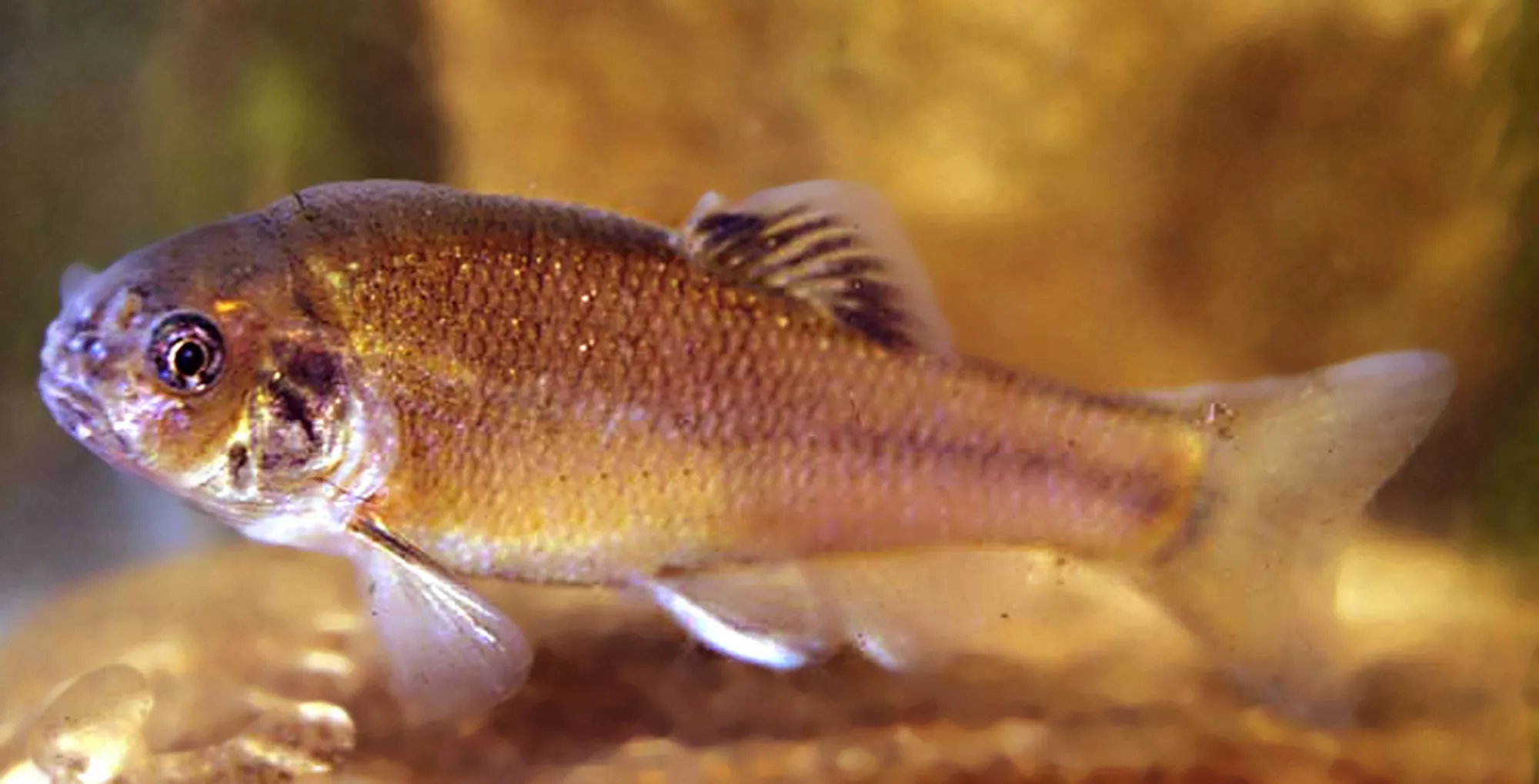
Fathead Minnow Pimephales promelas
> Fathead Minnows are a schooling fish and prefer to be in schools of familiar individuals, which they identify using chemical cues.
> They have been widely introduced as bait fish.
> They release pheromones to warn conspecifics of the presence of predators or when males court and attract females.



Identification Tips
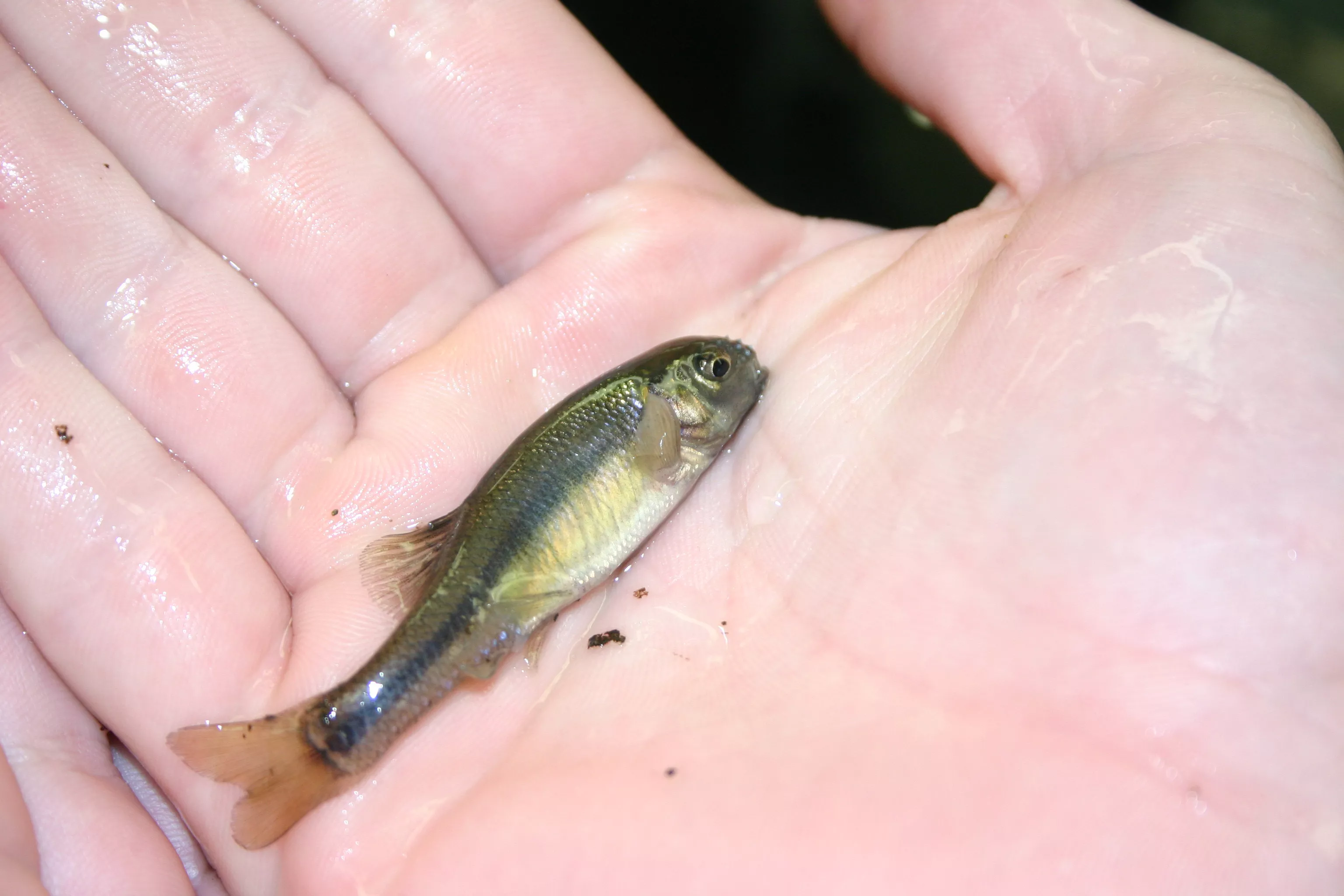
> Fathead Minnows have deep compressed body that are dark olive with dusky stripes and dull pale yellow underbellies.
> They have short heads with a blunt snout, round eyes, and pharyngeal teeth
> Their fins are clear, and the tail fin is dusky in color with a black spot midway up the leading edge. The origin of the dorsal fin is over the origin of the pelvic fin.
> Breeding males have dark-colored heads, two broad white to gold bars on the side, black fins, and a grey fleshy pad on the nape.
Natural History
> Fathead Minnows reach reproductive maturity after 4 or 5 months and their lifespan is 2-3 years.
> Fathead Minnows spawn between May and September when water temperature is 16-30°C, and usually at night. Females spawn multiple times, up to 16-26 times, per season and generally release about 400 eggs for each spawning event.
> Males prepare nest sites on the underside of horizontal objects in shallow water areas with sandy substrates. Eggs are released beneath the object and adhere to the ceiling. Males guard the nest after spawning.
Distribution
> Fathead Minnows are native to Central-Eastern North America from Quebec and Northwest Territories south to Alabama and Texas and Mexico. They have been widely introduced to Colorado, Arizona, New Mexico, Oregon, and Mexico.
> They have been introduced to the Willamette River basin, but are rarely found in the mainstem. After extensive sampling in 2011-2013 and 2021-2013, they were found in only two isolated locations. Based on OSU Fish Collection records, they have been found in a small number of locations in tributaries and ponds.
Size
> Fathead Minnows are small at 1.97-4 inches (5-10 cm) and 0.07-0.18 ounces (2-5 g).
Habitat
> The Fathead Minnow lives in ponds and muddy pools or slow-moving waters in headwaters, streams, and small rivers.
Diet
> Fathead Minnows are benthic filter feeders. A large portion of their diet is comprised of benthic algae and protozoans. They also eat diatoms, filamentous algae, small crustaceans, and insect larvae.
Management Considerations
> Because of their tolerance for low quality habitats, including tolerating high water temperature and turbidity, variable salinity and pH and low oxygen, Fathead Minnows may be more tolerant of poor conditions and compete with native fishes in the Willamette River basin.
References
For more information, see references.