

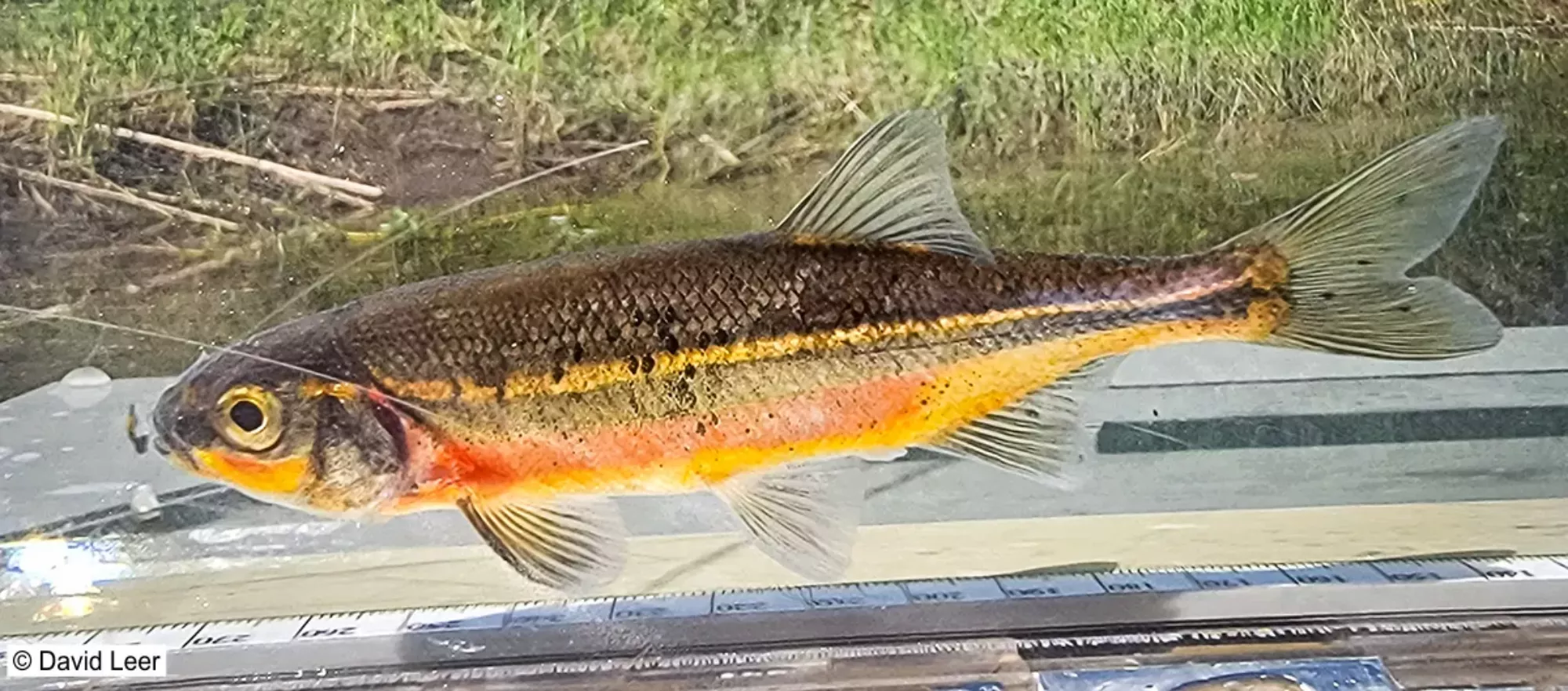
Redside Shiner Richardsonius balteatus
Conservation Status: Not listed under the Endangered Species Act
> There are four different populations of Redside Shiner in Oregon.
> Redside Shiners can compete with salmonids for food.
> They can hybridize with other species in the Cyprinidae family, including Northern Pikeminnow, Chiselmouth, Dace, and Peamouth.

Identification Tips
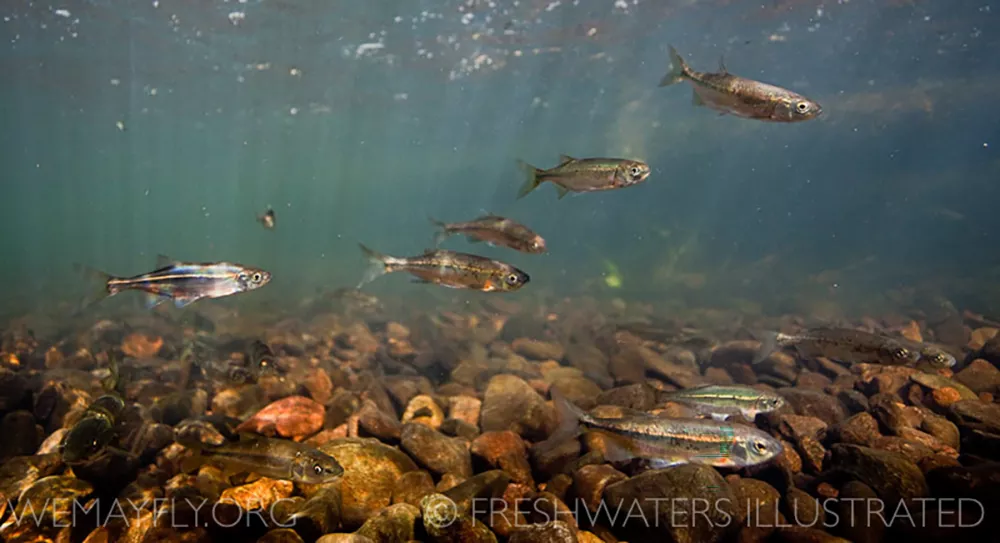
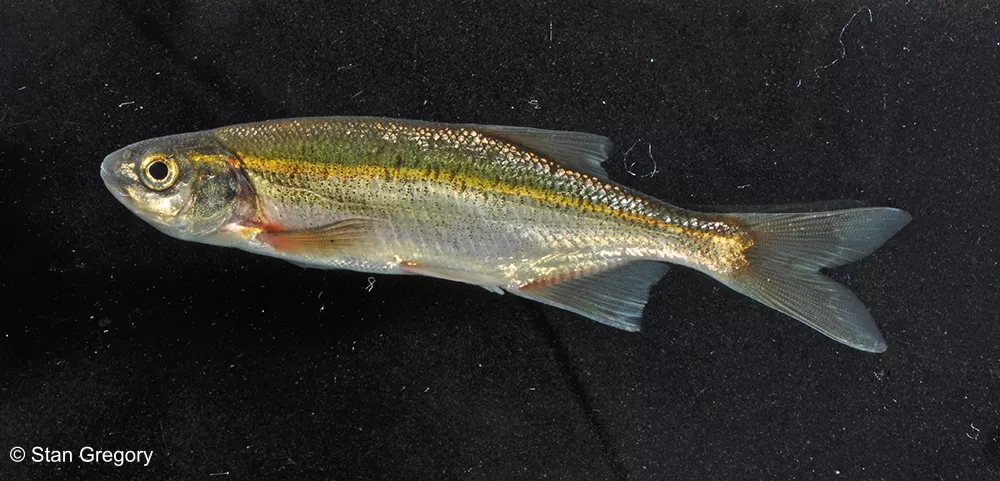
> Redside Shiners have a deep body and a narrow caudal peduncle in relation to a large, deeply forked caudal fin.
> Their dorsal fin sits above the starting portion of the seemingly large anal fin.
> The sides of males become bright red during the breeding season, which is how they got their common name.
> Redside Shiners have small scales that tend to rub off easily.
Natural History
> Redside Shiners are a schooling fish and exhibit this behavior in pools, runs, streams, medium-sized rivers, and lakes.
> They tend to spawn in streams over gravel or submerged vegetation.
> Once the eggs are fertilized, they adhere to the bottom and hatch in about 15 days.
> Individuals sexually mature at 2 to 3 years of age and can live up to 5 years.
Range
> Redside Shiners are native to the Pacific Northwest, including Oregon, Washington, Idaho, central Utah, southern British Columbia, and the western parts of Wyoming and Montana.
> In Oregon, they are found in the Columbia, Rogue, and Klamath Rivers.
Size
> Juvenile Redside Shiners are commonly about 3 inches (7.6 cm) in length, and adults are commonly about 5 to 7 inches (12.7 to 18 cm).
Habitat
> Redside Shiners are found in lakes, ponds, rivers, streams, sloughs, and ditches. However, their preferred habitat is cold, slow-moving sections of water, whether in rivers or lower sections of large bodies of water such as lakes.
> They are also usually found over muddy or sandy areas with vegetation.
Diet
> Adults mainly feed on insects, but they also eat mollusks, plankton, eggs, and other fish.
> Fry eat zooplankton, crustaceans, and plant material.
Conservation and Management
> From 2011–2013 to 2021–2023, there was a decline in abundance that differed by river slice position in the Willamette River.
Similar Species
> See Minnow Comparison Grid.
> Chiselmouth, which have a cartilaginous ridge in the mouth.
> Northern Pikeminnow, which have a caudal dot and a much larger mouth.
> Oregon Chub, which can be smaller and more drab in color.
> Peamouth, which have a larger, circular-shaped mouth.
References
For more information, see references.