


Bull Trout Salvelinus confluentus
> The head and mouth are unusually large for salmonids, giving the Bull Trout its name.
> Pure Bull Trout have spotless dorsal or tails fins, which have led to the phrase promoted by fishery managers, “fins black, put it back.”
> Bull Trout are the only native char in the Willamette River, and Oregon fishing regulations for most rivers call for them to be released unharmed if captured.
> Bull Trout require cold water to survive from 52°F to 59°F (11-15°C). Spawning
begins in the fall when water temperature decreases to less than 48°F (9°C). This is generally colder than other cold-water fishes need.
> Over the past few decades, Bull Trout have declined substantially from their historic distribution and abundance due to habitat degradation, over-exploitation, reduced water quality, and decreased connectivity of critical habitat. Bull Trout have been locally extinct from California (McCloud River) since the 1970s, and only a single, isolated population exists in Nevada in the Jarbridge River.
> Bull Trout previously were also known as Dolly Varden, but this name is now attributed to its sister species.
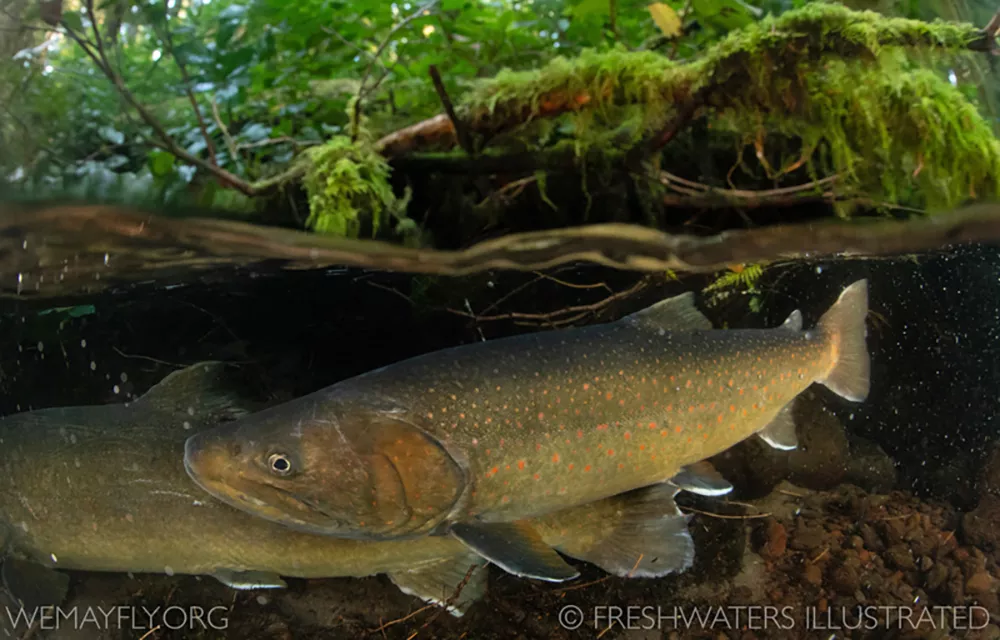


Identification Tips
> Like other char, the fins along the underside of Bull Trout have leading white edges.
> Bull Trout are gray in color infused with green. Their body is covered in small white or pale yellow spots, but some spots along the side can be deep orange or red.
> Pure Bull Trout have spotless dorsal and tail fins, which has led to the phrase promoted by fishery managers, “fins black, put it back.”
Natural History
> Bull Trout are a char species found in freshwater ecosystems. More generally, trout have light bodies with dark spots, whereas char have dark bodies with light spots.
> Juvenile Bull Trout generally rear for 1–3 years in headwater tributaries before moving downstream to larger rivers, lakes, or the Pacific Ocean.
> Bull Trout require large, unfragmented, cold-water habitats to persist and are highly susceptible to human stressors.
> Many large, stable populations of Bull Trout are adfluvial, meaning they spawn in tributary streams where the young rear from 1 to 4 years before migrating to a lake system, where they grow to maturity. Rearing takes place in lakes, reservoirs, or relatively pristine headwater habitats.
> Bull Trout spawning generally occurs from mid-August to October.
> Increased water temperatures can affect their spawning distribution and abundance due to the loss of thermally suitable migratory habitats (<59 °F or 15 °C). Connected cold-water refuges are required for Bull Trout to migrate in rivers.
> Bull Trout may be particularly vulnerable to a warming climate because cold-water temperatures constrain their spawning (<48.2 °F or 9 °C) and early rearing (<59 °F or 12 °C). This makes them highly vulnerable to temperature changes from habitat degradation, dam management, or climate change.
Range
> Bull Trout are native to northwestern North America and are currently found in Oregon, Washington, Montana, Idaho, Nevada, southern Alaska, and Canada.
> In the Willamette River basin, they are found in the Upper Willamette River and the Clackamas River.
Size
> Migratory Bull Trout are much larger than stream-living individuals and can grow up to 41 inches (103 cm) in length and weigh up to 32 lbs (14.5 kg).
Habitat
> Bull Trout live in freshwater streams, rivers, and lakes, but there are reports of individuals migrating from one coastal river to another.
> They are found in cold, clear waters across their range.
> Besides their strict temperature requirements, they need clean gravel beds, deep pools, complex habitats, and large connected habitats to accommodate their freshwater spawning migrations.
Diet
> Bull Trout eat insects and zooplankton, and as they grow, they feed heavily on salmon eggs, fry, and other fishes.
Conservation and Management
> Bull Trout are listed as threatened in the United States under the Endangered Species Act. Three core areas have been identified for Bull Trout in Oregon, one of which is the Upper Willamette River. They are listed as a sensitive species in Oregon.
References
For more information, see references.