

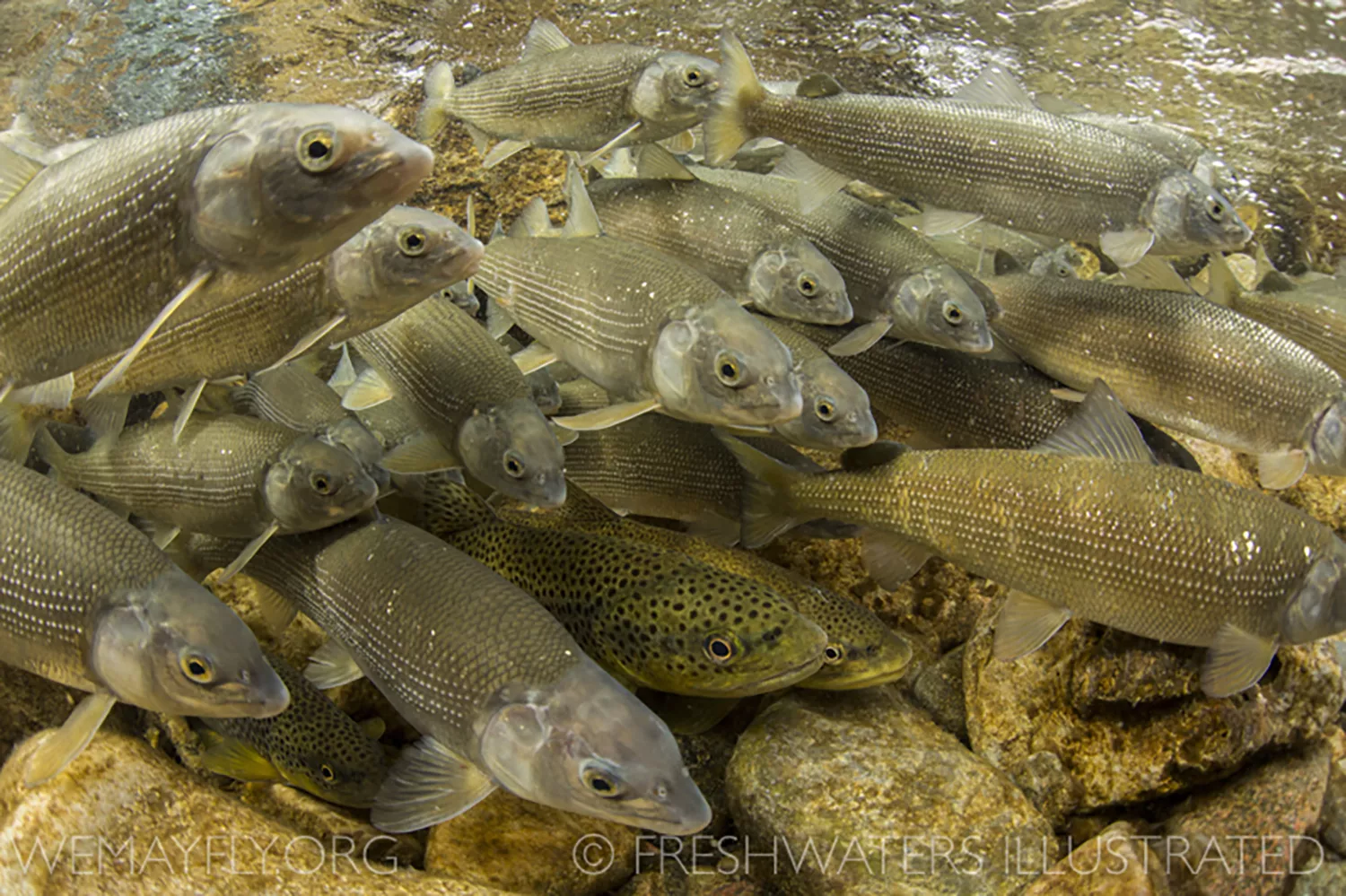
Mountain Whitefish Prosopium williamsoni clarkii
Conservation Status: Not listed under the Endangered Species Act
> Pictured above: Mountain Whitefish and three O. mykiss against rocks below. (photo Freshwaters Illustrated)
> Despite being viewed by anglers as a second-class game fish, they are one of the best-eating freshwater fish.
> Unlike other salmonids, Mountain Whitefish do not build redds.
> Mountain Whitefish are also called Oregon mountain whitefish, Rocky Mountain whitefish, Mister White, whitefish

Identification Tips
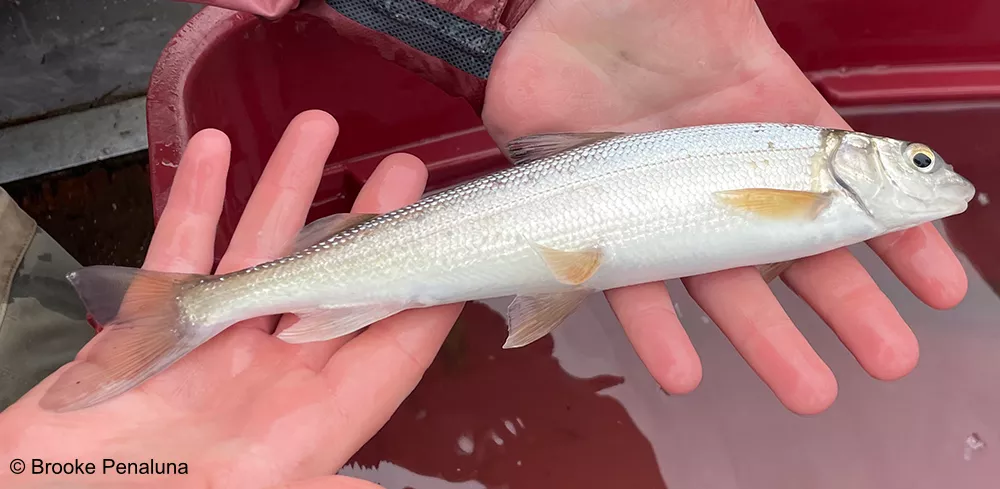
> Mountain Whitefish have an adipose fin like other salmonids. In this case, it is large, and its base length is equal to or greater than the width (depth) of the caudal peduncle (tail base) in juveniles. It becomes proportionally smaller as the fish grows.
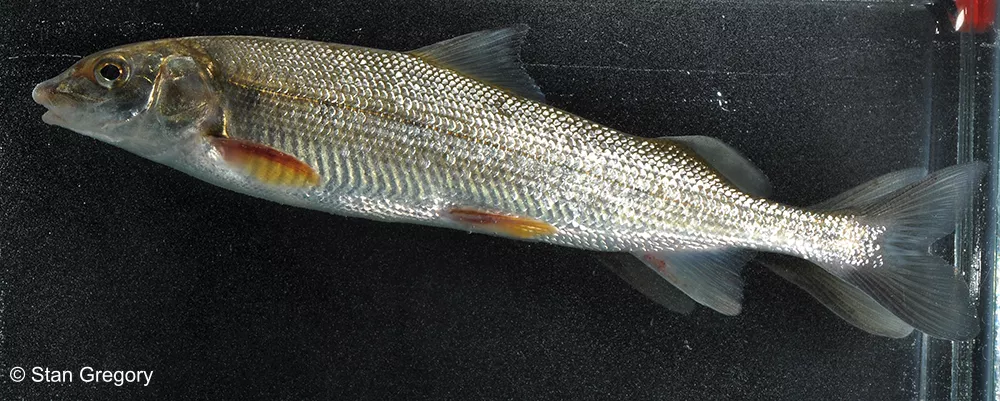
> Their color ranges from light brown on the back to silvery-gray on the sides and belly, sometimes with blue tints, especially in lakes.
> They have a prominent snout with a small, down-turned mouth without teeth.
> They have a single flap of skin between the nostrils, large scales similar to graylings, and a deeply forked caudal fin.
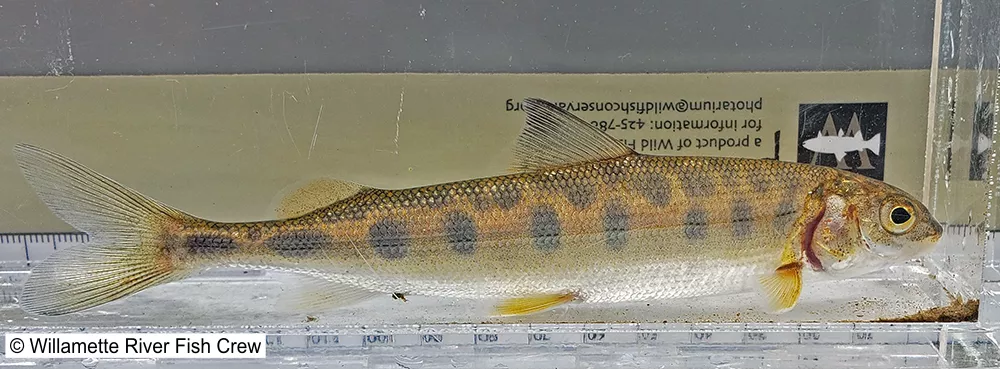
> Juveniles have parr marks on their sides, like other salmonids.
Natural History
> Mountain Whitefish can display complex movement patterns throughout their life based on feeding, spawning, and overwintering needs.
> Spawning occurs between October and December with temperatures around 1–11 °C, and high embryo mortality occurs at temperatures above 9 °C. Mountain Whitefish move in large numbers to spawning habitats. Fish become mature in their second through fourth year. Females produce about 5,000 eggs on average, and incubation takes approximately 6–10 weeks. Upon hatching, young fish float downstream to backwaters and grow before returning to deeper, quicker areas.
> Growth can be highly variable due to habitat, food availability, and temperature. Fish tend to grow more quickly at lower elevations and to larger sizes in larger water bodies.
Range
> While most populations of Mountain Whitefish are semi-isolated, the species has a wide distribution throughout the American West, on both sides of the Continental Divide from southwestern Canada to southern Utah.
> Mountain Whitefish are widely distributed in the Columbia River basin. In the Willamette River, they are most abundant in the upper, colder waters of the tributaries that drain the western slopes of the Cascade Mountains.
Size
> Mountain Whitefish typically range from 9–12 inches (23–30 cm) in length and weigh about 6–11 oz (170–312 g). The reported record size was 28 inches (70 cm) and 6.4 lbs (2.9 kg).
Habitat
> Mountain Whitefish prefer cold streams over lakes, but they also occur in some high mountain lakes.
> In rivers and streams, they occupy deep pools (36–48 in / 91–122 cm), and in lakes they prefer areas at least 30 ft (10 m) deep. Their preferred temperature ranges from 48–51 °F (8.8–10.5 °C), but they can tolerate up to 70 °F (21 °C) in summer.
Lifespan
> The typical lifespan is 7–9 years, with a recorded maximum of 18 years.
Diet
> Mountain Whitefish frequently feed at night and twilight on aquatic invertebrate larvae and nymphs, but they also school and rise to feed on fallen terrestrial insects and fish eggs when available. The diversity of their diet increases as their size increases.
Conservation and Management
> Although this species is not listed under the Endangered Species Act, it is considered vulnerable in California, Nevada, South Dakota, British Columbia, and Washington; imperiled in Colorado; critically imperiled in Saskatchewan; and presumed extirpated in Nebraska. Most populations are considered stable.
> From 2011–2013 to 2021–2023, there was a decline in occupancy (number of sites where they were found) that differed by river slice position in the Willamette River.
References
For more information, see references.