


Green sunfish Lepomis cyanellus
> Green Sunfish is aggressive and stocked as a sportfish, but rarely reaches desirable catch size.
> Green Sunfish can hybridize with all other sunfishes.
> Green Sunfish are tolerant of higher temperatures and lower dissolved oxygen than must sunfishes.
> In the Southwest United States, they are often the first fish to recolonize streams impacted by drought.



Identification Tips
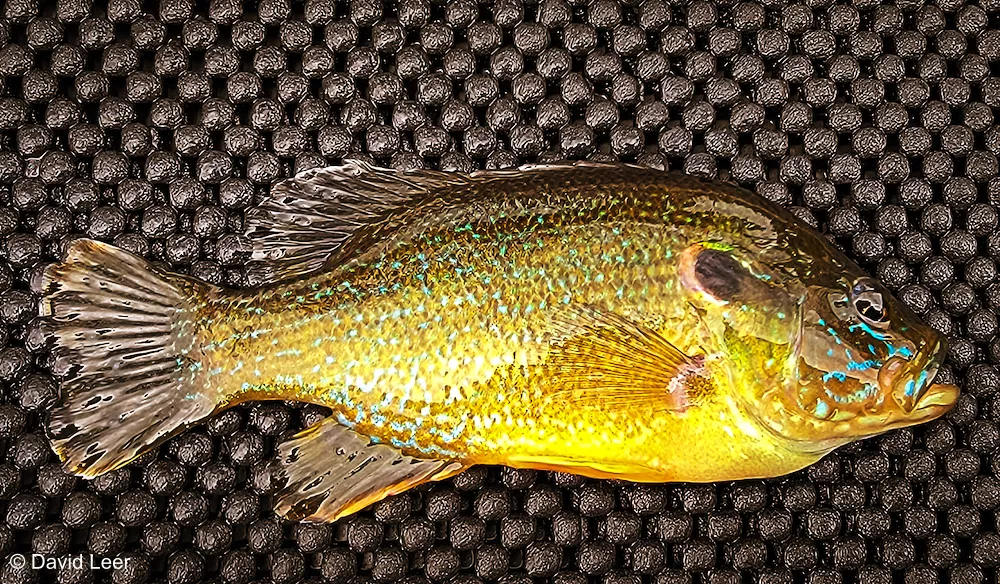
> Green Sunfish are thicker than other sunfish, have a large mouth, and their upper jaw extends to mid-eye.
> They have a dark green body with lighter underside, vibrant turquoise or blue streaks on cheeks, bright iridescent blue spotting on body, cream-colored edging on fins, and a dark spot at the base of dorsal fin. Their fins can have orange tips.
> Their pectoral fin does not extend beyond eye when bent forward. The pectoral fin has 1 spine and the anal fin has three spines. The caudal fin is slightly forked.
> The two dorsal fins are joined and there are 9 to 11 spines on the first dorsal fin.
Natural History
> Green Sunfish are very aggressive and territorial. One fish can stay in an area for many years defending its chosen territory from other fish.
> They mature in their 3rd year and begin spawning when water temperatures reach about 66 ⁰F (19 ⁰C). Males build nests on small gravel bottoms, either individually or in colonies. Their courtship includes grunting and females can deposit around 2,000 to 10,000 eggs, which adhere to the gravel substrate and are guarded by the male for 5 to 7 days. Males and females both spawn with multiple partners.
Range
> They are native to the Mississippi drainage in East-Central North America but have now been introduced throughout North America.
> They are occasionally found in the mainstem Willamette River channel, off-channel habitats, and floodplain ponds. Their known distribution in the upper reaches has expanded downstream in recent years.
Size
> Many fish rarely reach over about 6 inches (15 cm) but can reach up to twice that size.
Habitat
> Green Sunfish are found in small warm streams and rivers often near vegetation. When in rivers they are often found in rip rap and old car bodies.
> They prefer temperatures ranging between 80-86 ⁰F (26-30 ⁰C) but can withstand up to 100 ⁰F (38 ⁰C) for short amounts of time. They can also survive in water with less than 1 mg/liter of dissolved oxygen and alkalinities up to 2,000 mg/liter which are extreme environments.
Lifespan
> They live to 6-7 years in their nonnative systems, but can live up to 10 years.
Diet
> They are opportunistic feeders, eating small plants, aquatic invertebrates, especially immature insects, and mollusks when young. They consume larger insects and small fish as they grow and mature.
Management And Conservation Actions
> Green Sunfish represent an invasive species which has been stocked in Oregon for sportfishing purposes or as food for larger centrarchids.
Similar Species
> Warmouth show some resemblance with Green Sunfish, but they lack the turquoise mottling on the gill cover and the dark spot at the rear base of the dorsal fin.
References
For more information, see references.