

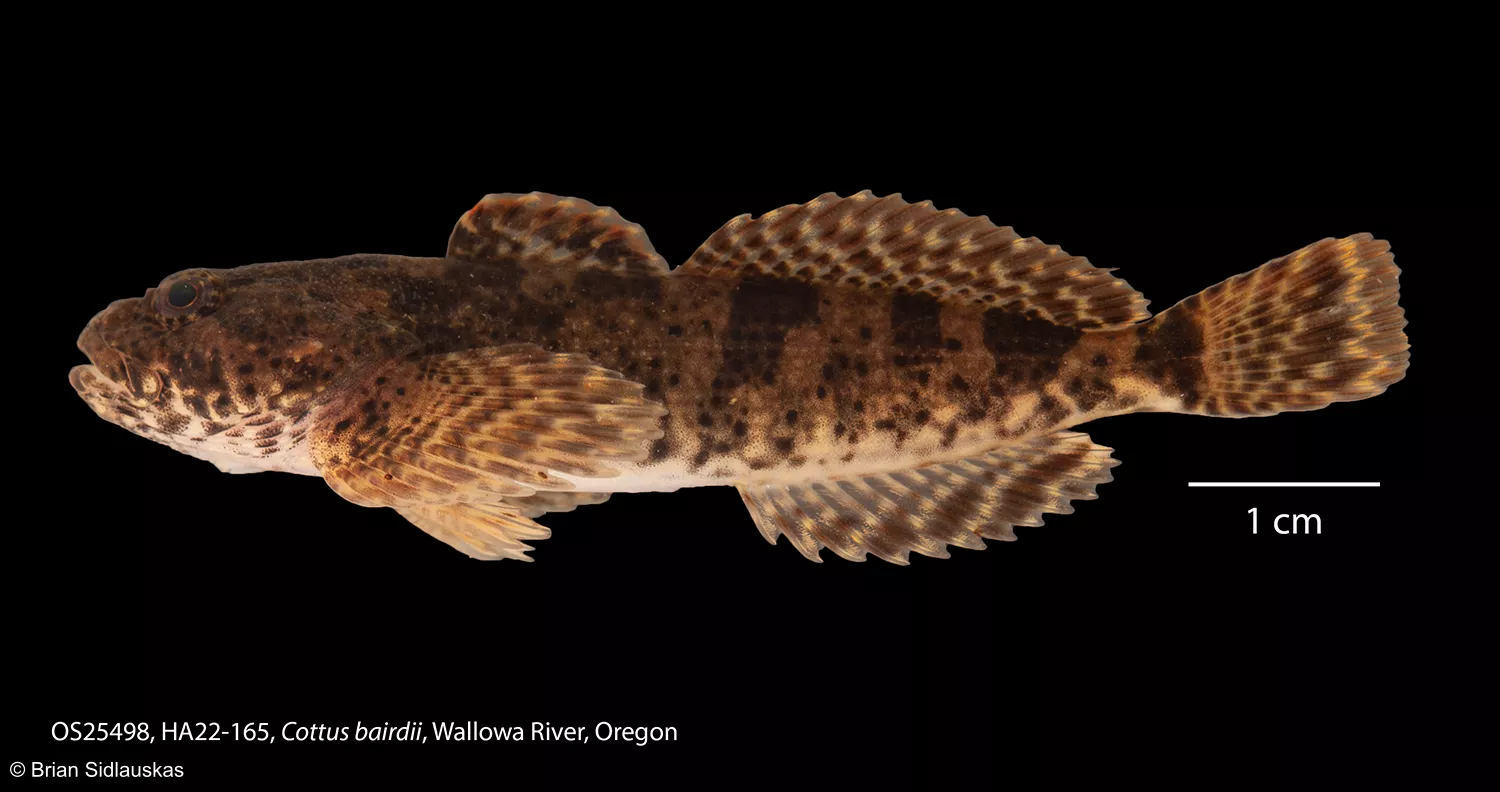
Mottled sculpin Cottus bairdii
Conservation Status: Not listed under the Endangered Species Act
> This sculpin is part of a “complex” of species yet to be properly identified and classified.
> Many experts believe that we are actually looking at several different species under the Cottus bairdii name. However, some classify the populations in the Columbia River basin and neighboring areas as Cottus hubbsi, but there is no consensus on this yet.
Identification Tips
> Mottled Sculpins have the typical robust body, large flattened head, and fan-shaped pectoral fins of all sculpins. This species has an incomplete lateral line, two dorsal fins joined at the base, and three preopercular spines.
> They are light to dark brown with black and brown mottling on the back and sides.
> There are large black spots on the front and back of the first dorsal fin. They also have a uniformly speckled chin, banded pectoral fins, and a speckled caudal fin.
Natural History
> Mottled Sculpins reach reproductive maturity at 2–3 years of age.
> Reproduction occurs in April and May in slow- to fast-moving clear water.
> Males create nests under rocks or submerged wood where females adhere their eggs to the ceiling of the cavity. Males guard the nest until the eggs hatch, fanning them with their pectoral fins to provide current and oxygen, and chase females away to prevent egg predation.
> They may live for 5–6 years.
Range
> This species complex has a broad range from British Columbia to North Carolina, but its distribution is disjunct, with separate eastern and western populations.
> Some experts consider the populations west of the Rocky Mountains and in the Columbia River basin—from British Columbia to Oregon—to belong to a different species.
Size
> Mottled Sculpins are typically 4–6 inches (43–125 mm) in length.
Habitat
> Mottled Sculpins can be found in rubble and gravel riffles at headwaters of creeks and in rivers, springs, and their effluents, as well as in rocky lakeshores.
> They prefer rapid to moderate currents and clear, shallow waters (no more than 2 ft). Although they are often found in cold water, they appear to tolerate warmer temperatures without issue.
Diet
> As with most fish, their diet changes with size. In general, they feed primarily on aquatic insects but also consume crustaceans, snails, fish eggs, small fish, and some plant material.
Conservation and Management
> No specific conservation concerns have been identified for this species within the Willamette River basin.
Species
> Paiute Sculpin
> Prickly Sculpin
> Reticulate Sculpin
> Riffle Sculpin
> Torrent Sculpin
References
For more information, see references.