


Channel Catfish Ictalurus punctatus
> Channel Catfish do not have scales, rather they have soft, smooth skin.
> They have taste buds on the entire surface of the body and inside the mouth, gill arches, and pharynx. Taste is the main way they detect prey.
> Channel Catfish are raised in aquaculture and are highly valued for their taste.


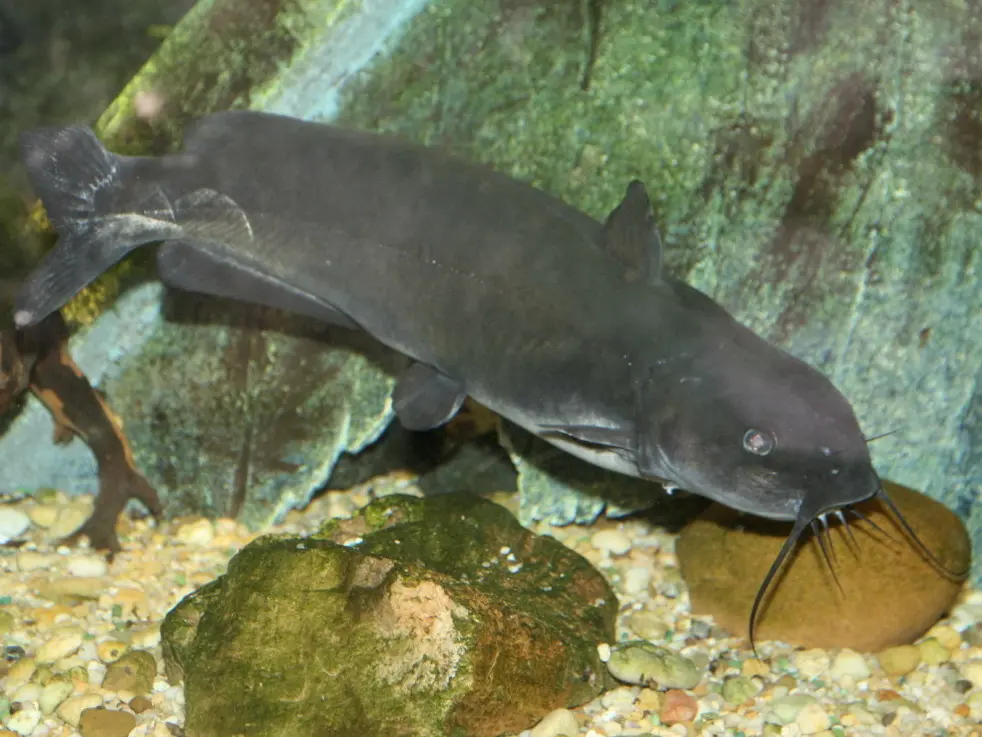
Identification Tips
> Channel Catfish have 8 barbels, 6 pointing downward and 2 short ones on the top of the snout pointing upwards.
> Their tail fin is pointed and deeply forked, different from Yellow or Brown Bullheads that have rounded or square tails.
> Their snout overhangs the jaw slightly.
> They have a moderately large-sized adipose fin.
> Juvenile Channel Catfish have black spots and their fins have black margins. As they age, the black fades and, in some cases, it may disappear entirely.
Natural History
> Channel Catfish generally spawn from late spring through early summer, when water temperatures are near 80° F (26.67° C). If residing in lakes or ponds, they may move into tributaries to spawn.
> Males locate and prepare nest sites for spawning, preferably in areas with overhanging banks or submerged brush piles or logs, or other bottom structure. Females deposit the eggs in one gelatinous mass. After fertilization, males remain at the nest and fan the eggs until they hatch (5-10 days).
> Juveniles absorb their yolk sac for 5-10 days after hatching before leaving the nest to search for food in the upper water column near the surface. The male continues to guard the nest until the juveniles disperse.
Distribution
> Channel Catfish are native to the Mississippi River basin, but they have been widely introduced across North America. In Oregon, they are considered established in the Willamette River basin, but are not very abundant.
Size
> They are the largest of all of the catfishes established in the Willamette River basin, growing to 16-24 inches (40.6-61 cm) and 3-6 lb (1.4-2.7 kg), but can get as large as 48 inches (120 cm) and 30 lb (13.61 kg).
Habitat
> Channel Catfish are found in rivers with clear flowing water, ponds, and lakes. They are normally bottom-associated, but will search for prey higher in the water column.
> They prefer areas with sand, gravel, or rubble substrate over areas with mud substrate.
Diet
> They eat small macroinvertebrates and aquatic insects. As they grow, they also eat crustaceans, mollusks (clams and mussels), crayfish, and fishes.
> Adult Channel Catfish are opportunistic and eat almost any prey they encounter.
Similar Species
> They look similar to Yellow and Brown Bullhead, but differ in coloration, tail shape (which is forked in Channel Catfish rather than rounded).
> Channel Catfish can reach 40 lb (18 kg), although most individuals are about 10 lb (4.5 kg). In the Willamette River, Yellow and Bullhead seldom exceed 2 lb (0.9 kg).
References
For more information, see references.