


Northern Pikeminnow Ptychocheilus oregonensis
Conservation Status: Not listed under the Endangered Species Act
> Northern Pikeminnow are the most common native predatory fish in the Willamette River.
> They can live up to 20 years.
> Northern Pikeminnow in the Columbia River basin aggregate below dams to take advantage of the vulnerability of outgoing juvenile salmonids to predation.
> There is a bounty system for Northern Pikemonnow in the mainstem Columbia River, with some fishers earning more than $80,000 annually. The effectiveness of the bounty system for increasing returning adult salmon has never been demonstrated.
> A closely related species, Colorado Pikeminnow, is listed as Endangered under the Endangered Species Act.
Identification Tips
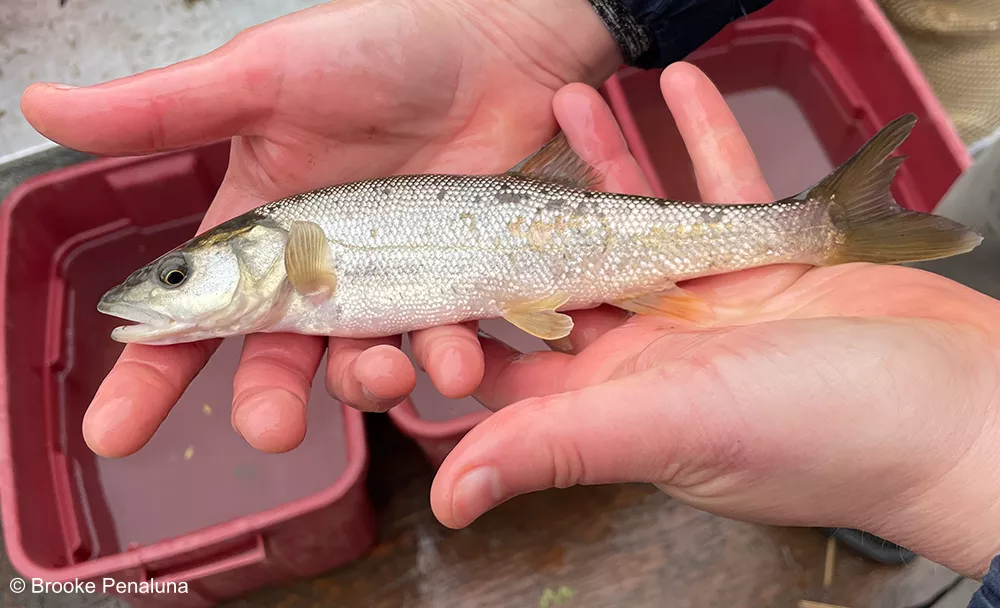
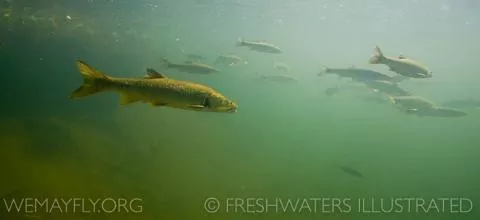
> Northern Pikeminnow are silver-sided with a prominent black dot at the base of the caudal fin, which is typically deeply forked.
> Adults can have a large terminal mouth that extends past the eye.
> Northern Pikeminnow coloration varies from an olive green/tan to silver with bright orange fins when spawning.
Natural History
> The Northern Pikeminnow is a highly mobile piscivorous fish, and accordingly they occupy a wide variety of habitats, including deep river channels, river shorelines, and slow-water sloughs. In slow-moving habitats, they ambush prey in adjacent slow or fast water.
> They spawn in gravelly substrate in stream habitats.
> Females lay adhesive eggs and can spawn multiple times if all eggs are not released during one spawning attempt.
> No parental care is given to rearing young, and once young are able to swim, they display schooling behavior.
Range
> Northern Pikeminnow are native to the Pacific slope of western North America.
> They are found throughout British Columbia, Washington, Oregon, Idaho, Montana, and Nevada.
> They are found throughout the Columbia River basin and its tributaries, including the Willamette and Deschutes Rivers.
Size
> Juvenile Northern Pikeminnows are around 4 inches (10 cm) in size, but can grow up to 12 to 24 inches (30 to 60 cm) as adults.
Habitat
> Northern Pikeminnow are a predatory fish capable of using multiple habitats in the Willamette River, including mainstem, sloughs, and tributaries.
> They are strong swimmers and can swim throughout the river in fast or slow waters.
Diet
> Juvenile Northern Pikeminnow feed more extensively on macroinvertebrates until they can easily ingest smaller fish.
> Adults are piscivorous and have been considered a threat to juvenile salmon and smolts.
Conservation and Management
> From 2011–2013 to 2021–2023, there was a decline in abundance that differed by river slice position in the Willamette River between decades.
Similar Species
> Chiselmouth, which have a cartilaginous ridge in the mouth.
> Peamouth, which does not have the dark dot at the base of the caudal fin.
> Redside Shiner, which are more colorful and have a deeper, less elongated body.
References
For more information, see references.