


Sand Roller Percopsis transmontana
Conservation Status: Not listed under the Endangered Species Act
> Sand Rollers are endemic to the Columbia River drainage and found nowhere else in the world.
> Sand Rollers are nocturnal.
> In its family Percopsidae, it is one of two species.
> Sand Rollers were first collected at the mouth of the Umatilla River in 1892 and were described by Rosa Smith Eigenmann and Carl Eigenmann. Rosa Smith Eigenmann was the first female ichthyologist in North America.


Identification Tips
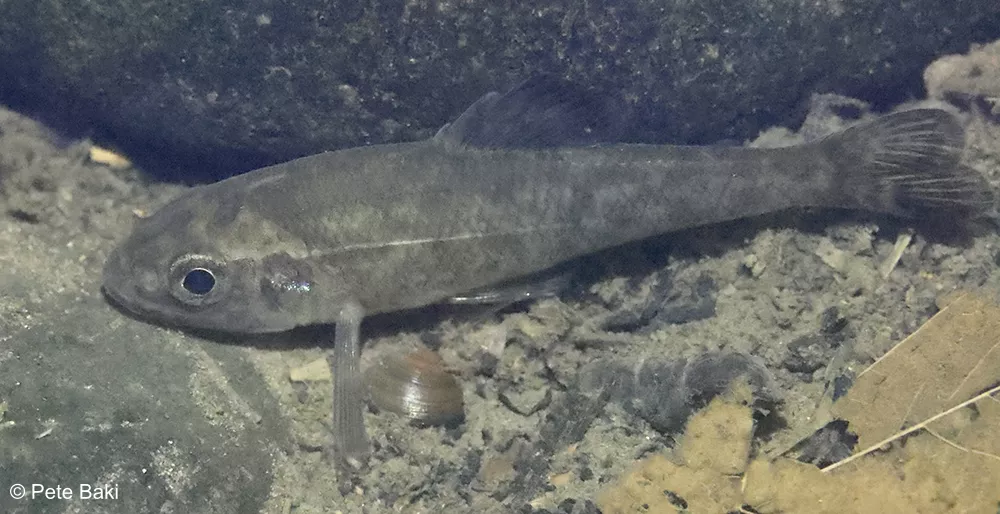
> Sand Rollers are small fish with a robust body that rarely exceeds 100 mm in fork length.
> They have a single dorsal fin with a dorsal spine, pelvic fin spines, an incomplete lateral line, and the presence of an adipose fin.
> Their coloration ranges from blue-green to mottled brown.
Natural History
> Sand Rollers exhibit cryptic daytime behavior, which limits understanding of their full life history.
> They may move into shallower waters at night.
> Sand Rollers reach sexual maturity by 2–3 years of age and likely spawn in spring, based on observations of gravid females caught during this season.
> The oldest recorded individual was estimated at 6 years of age.
Range
> Sand Rollers are endemic to the Columbia River. Within the Willamette River basin, most encounters occur between Albany and Eugene.
Size
> Sand Rollers are small, robust fish rarely exceeding 4 inches (10 cm) in fork length. Juveniles typically range from ½ inch to 1 inch (1.5–2.5 cm).
Habitat
> They are found in calmer waters with vegetation and natural structures such as large wood and rocks, sometimes using large crevices under tree roots or in riprap.
> Sand Rollers use shallower habitats of 3–6 ft, including pools and low-gradient reaches, but have been recorded moving into deeper habitats during the day.
Diet
> They eat insects and other invertebrates such as crustaceans.
> They exhibit an apparent dietary shift at approximately 40 mm in length—larger Sand Rollers consume trichopteran larvae, while smaller individuals feed on zooplankton and smaller larvae.
> During colder winter months (December–March), gut contents may be empty or limited, likely due to lower food availability and activity.
Conservation and Management
> From 2011–2013 to 2021–2023, there was a decline in abundance that differed by river slice position in the Willamette River.
Similar Species
> Oregon Chub are less stout and more drab in coloration.
References
For more information, see references.