

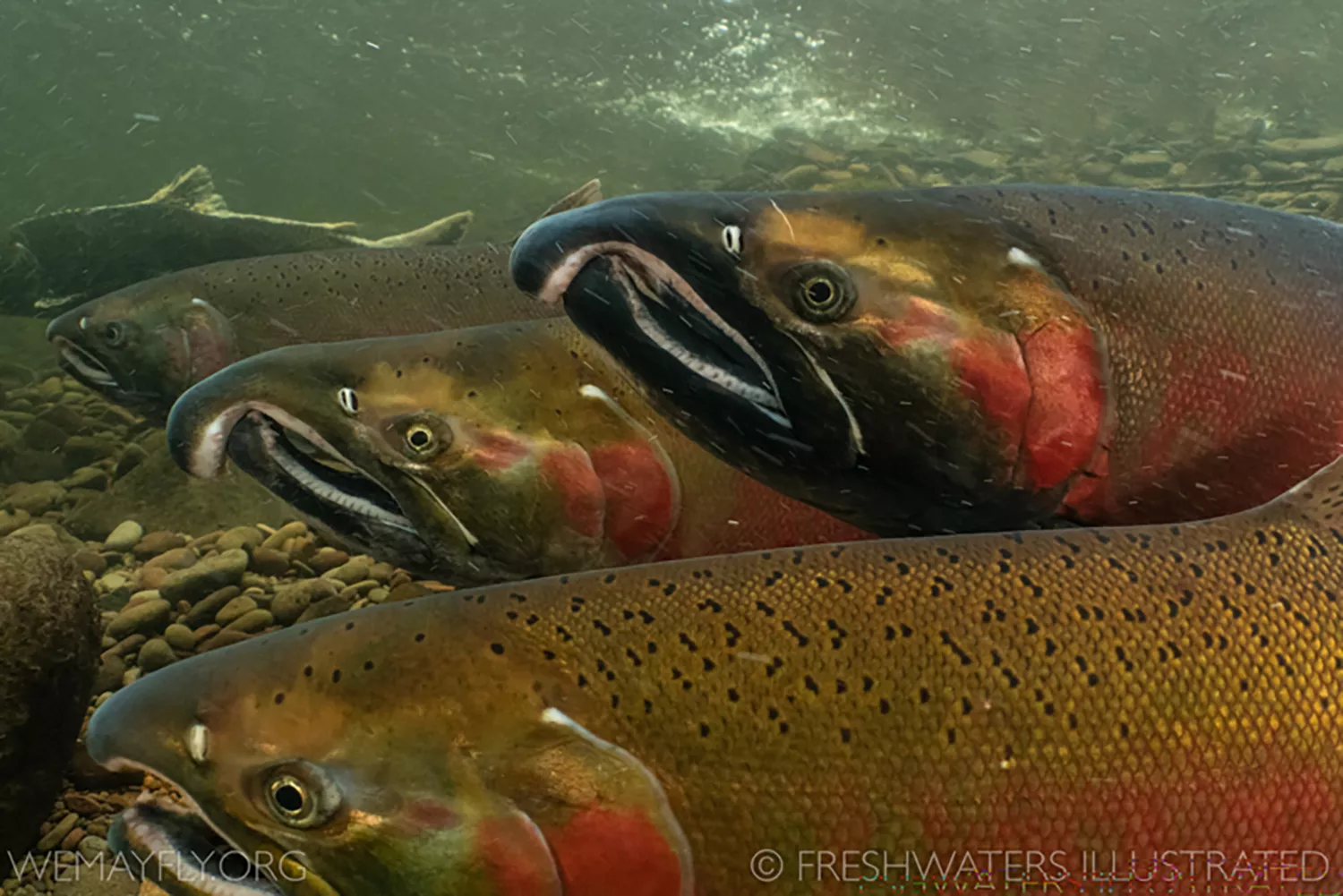
Coho Salmon Oncorhynchus kisutch
Conservation Status: Threatened under the Endangered Species Act
> Other common names for Coho include silver salmon, hooknose and blueback
> In Oregon, most juvenile coho salmon enter the ocean as one-year-old fish, but in Northern British Columbia and Alaska, many juveniles migrate to the ocean at age 2.
> Coho Salmon are not naturally found in the Willamette River basin above Willamette Falls, but a hatchery program supplements the basin to It is unclear whether Coho Salmon ever naturally passed the falls. It is possible that at high flow they could have passed. As of recent, hatchery program supplement Coho Salmon in the basin.
> A small proportion of males, known as Jacks, mature sexually during their first summer in the ocean and spawn as “teenagers” a year earlier than normal.
> Coho Salmon tend to prefer coastal rivers or tributaries in the lower/middle sections of large rivers.
> Females can lay up to 4,500 eggs.


Identification Tips
> Although Coho Salmon closely resemble their sister species, the Chinook Salmon, adults are distinguishable by their white gums, small spots that may or may not be present on the back, and usually small round spots on the upper lobe of the tail.
> Bony segments in the fin rays of the tail can be felt by lightly running a fingernail along the top of a fin ray.
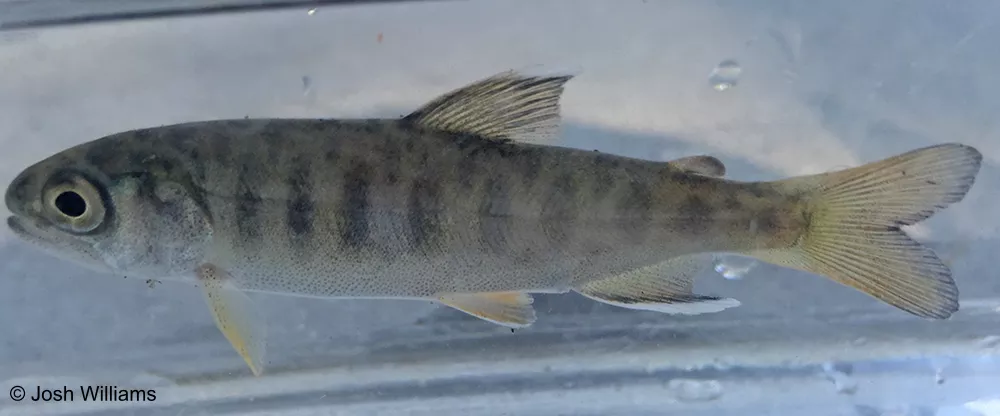
> Juveniles are identified by their narrow blotches of pigment (parr marks) along their lateral lines. These marks are smaller than the spaces between them. The edge of the anal fin is sickle-shaped, with a leading edge longer than the rest.
> Spawning fish turn dark red on their sides, and males develop pronounced hooked upper jaws.
Natural History
> Salmon are anadromous fish, meaning they migrate from freshwater to saltwater and back to their natal streams before the end of their life cycle. Coho Salmon spend their developmental stages of egg, fry, and parr (juvenile salmon after the first spring) in streams, usually in smaller tributaries of large rivers or small coastal streams, before smolting (adapting to saltwater) and moving to estuaries and then the ocean.
> They typically spend their first 14 months in freshwater (although some juveniles in coastal areas move as young fry into estuaries), and after two summers and one winter in the ocean (about 18–20 months), they return to spawn in freshwater as three-year-old fish. “Jacks” are the exception, as they return at two years old to reproduce.
> Spawning females dig a series of pockets or nests in the gravel where they lay their eggs. The entire area disturbed by a spawning female while digging several nests is called a redd, and its cleaner gravel makes it stand out from the darker stream substrate.
> Once they spawn, the adults die. Their carcasses provide vital nutrients for the river ecosystem and may feed juvenile salmon from the previous year still living in freshwater.
Range
> Coho Salmon are native to the western coast of the U.S. and Canada, and the northeastern coast of Asia to Hokkaido, Japan. They have also been stocked in the Great Lakes.
> In Oregon, Coho Salmon range from the lower Columbia River south along the coast to the Winchuck River near the California border.
> In the Willamette River, Coho Salmon were absent in the middle and upper basin until a fishway was installed at Willamette Falls in 1885, and stocking programs began in the 1950s.
Size
> Coho Salmon average about 8 to 12 lbs (3.6 to 5.4 kg) and are usually about 24 to 30 inches (61 to 76 cm) long. Individuals as long as 42.5 inches (108 cm) have been reported.
Habitat
> As with all anadromous species, Coho Salmon occur in both rivers and the ocean.
> They spawn and rear as juveniles in streams with small-to-medium gravel-rich substrate, pool and riffle habitats with abundant fallen logs, as well as backwater alcoves. Up to a third of juvenile Coho Salmon may move into coastal estuaries and small coastal lakes as fry during their first spring.
> They are adaptable. In areas where they have been introduced, such as the Great Lakes, they spend their entire lives in freshwater.
> Once in the ocean, most Coho Salmon prefer nearshore habitats to open waters; however, small numbers have been detected in the central Pacific Ocean.
Diet
> Coho Salmon prey on a variety of aquatic and terrestrial organisms.
> In rivers and streams, they consume mostly aquatic macroinvertebrates (e.g., insects and crustaceans) and some terrestrial insects.
> When they migrate to the ocean, they first rely on marine crustaceans, but later add pink and chum fry, anchovies, smelt, sand lance, herring, squid, and even jellyfish to their diet.
> When adults return to streams to spawn, they stop feeding, and their energy is used for reproductive development.
Conservation and Management
> The Willamette River and Lower Columbia River populations are listed as threatened under the Endangered Species Act and by the state of Oregon.
Conservation Status
> In addition to the Willamette River population being threatened under the Endangered Species Act, the Lower Columbia River population is threatened, and in the Upper Columbia River, the spring run is endangered.
Similar Species
> Chinook Salmon adults have black gums, and juveniles have a clear adipose fin window.
References
For more information, see references.