


Chinook Salmon Oncorhynchus tshawytscha
Conservation Status: Threatened under the Endangered Species Act
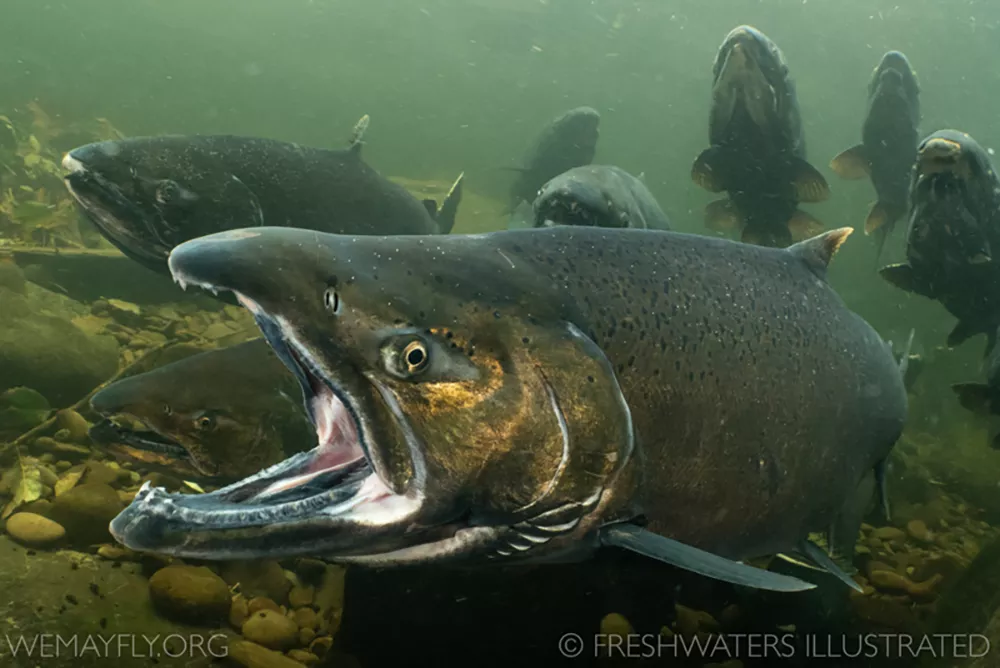
> Pictured above: Chinook Salmon (foreground) with O. mykiss in the background. (photo Freshwaters Illustrated)
> Their common name refers to the Chinook native peoples of the Pacific Northwest.
> Chinook Salmon are the largest-bodied species of all Pacific salmon growing up to 4.9 ft (1.48 m) and 97 lbs (44 kg).
> They lay their eggs in the largest-sized gravel of any salmon species.
> They can migrate up to 2,000 miles to reach their native spawning grounds.
> Female’s lay up to 17,000 eggs, but up to 85% of the eggs may be lost.
> Chinook Salmon are also known as king salmon, blackmouth, springer, Quinnat salmon, and Tyee salmon.


Identification Tips
> Although Chinook Salmon closely resemble their sister species, the Coho Salmon, adults are distinguishable by their black gums, large irregular spots on the back, and usually small round spots on both lobes of the tail.
> Bony segments in the fin rays of the tail cannot be felt by lightly running a fingernail along the top of a fin ray.
> Juveniles are identified by their large vertical blotches of pigment (parr marks) along their lateral lines. These marks are larger than the spaces in between them. The edge of the anal fin is straight.
> Spawning fish turn maroon or olive-brown. Males develop only a slightly curved upper jaw compared with some other salmon.
Natural History
> Salmon are anadromous fish, meaning they migrate from freshwater to saltwater and back to their natal streams before the end of their life cycle. Chinook Salmon spend their developmental stages—egg, fry, and parr (juvenile salmon after the first spring)—in rivers before smolting (adapting to salt water) and moving to estuaries and then the ocean. They spend 1–6 years in the ocean before returning to rivers and large tributaries to spawn and die. Of all Pacific salmon, they exhibit the greatest variability in their life-history stages.
> In the Willamette River basin, Chinook Salmon exhibit at least six major life-history types based on timing of downstream migration, location of rearing, and outmigration timing.
> Early-migrating stream-type (or spring) Chinook migrate upriver from May through July, whereas late-migrating ocean-type (or fall) Chinook migrate from September through December. Both spring and fall Chinook spawn from September through December. Juvenile Chinook generally undergo smoltification by April or May of each year. Spawning females dig a series of pockets or nests in the gravel where they lay their eggs. The entire area disturbed by a spawning female while digging several nests is called a redd, and its cleaner gravel makes it stand out from the darker stream substrate.
> Once they spawn, the adults die. Their carcasses provide vital nutrients for the river ecosystem and may feed juvenile salmon from the previous year still living in freshwater.
Range
> Chinook Salmon are found from southern California to Kotzebue Sound in Alaska.
> In the Willamette River, they are found throughout the Willamette River and its tributaries, from where the river meets the Columbia up into the McKenzie River.
Size
> Chinook Salmon are the largest of the Pacific salmon, measuring up to 58 inches (147 cm) and commonly ranging from 6 to 50 lbs (2.7 to 22.7 kg), with an average of 10 to 30 lbs (4.5 to 13.6 kg). Maximum size may reach 130 lbs (59 kg).
Habitat
> Chinook Salmon occupy multiple habitats throughout their lives in rivers, estuaries, and the ocean.
> They spend time as eggs, fry, and juveniles in lower rivers before smolting and moving to estuaries.
> They migrate to the ocean where they make the largest migrations of all the Pacific salmon, growing to adult size before returning to freshwater to spawn.
Diet
> Chinook Salmon are opportunistic feeders, and their diet varies depending on their habitat.
> In the ocean, they primarily feed on squid and smaller fish such as herring or mackerel.
> When they are juveniles in rivers, they typically eat macroinvertebrates such as caddisflies or stoneflies.
> When adults return to streams to spawn, they stop feeding and use their remaining energy for reproductive development.
Conservation and Management
> In addition to the Willamette River population being threatened under the Endangered Species Act, the Lower Columbia River population is threatened, and in the Upper Columbia River, the spring run is endangered. They are listed as a sensitive species by the state of Oregon.
> From 2011–2013 to 2021–2023, there was no apparent change in abundance or occupancy in the Willamette River.
Similar Species
> Coho Salmon adults have a white gumline, and their juveniles do not have a clear adipose window.
References
For more information, see references.